


I AM TAXONOMY BUSINESS PAGE
YES I AM A DLC_COMMITTEE TAX PAGE
Committee: Happiness Consultants & Coaches
DLC has developed a platform that includes certified Happiness specialists in the emotional quotient, financial imbalances, and work-life balance. happiness experts would assist the company and its employees in identifying any ongoing personal or professional relationship challenges, financial issues, and a good work-life balance.
Happiness is a muscle
Performance coaching: transforming the learning process
Mr. Mithilesh Chudgar guides the members on the importance of maintaining good mental health and how it benefits people from all walks of life. He discusses how he mentors entrepreneurs, athletes, students, and professionals in a variety of ways.
Finding Happiness where you can: In Pursuit of Peace
Mr. Prashant Mehta makes his debut in the world of podcasting as he takes the listeners through the gleeful world of happiness and the journey you can take towards to improve upon it.
Overcoming the Leadership Clog through Self Leadership & Happiness Lessons
Scalable Digital Solutions for The Pursuit of Well-being
Teju Nageswari takes DLC members through the pleasing and delightful world of happiness and the use of tech for pursuing the same.
Managing Corporate Stress: Getting through the Highs and Lows
Palak Magon takes the listeners through the gleeful journey of leaving stress, worries, and anxiety behind at the workplace. She talks about creating a culture that enables higher productivity whilst maintaining a high satisfactory level.
10 habits to become your happiest self
My career has spanned from being an army officer to running a multinational company. I have worked in big cities, small towns and everywhere across this planet! From reporting on global politics for a news channel or coaching business executives at top levels, my experiences are diverse, and my understanding of people is comparatively deeper.
While working and meeting people from all over the world, two groups, in particular, stood out: those with a smile on their face no matter what life dealt them; and others feeling sad or down-and-out. Being a people person, I closely observed the happy group of people and tried to understand their everyday habits that made this group of people very happy. However, before I talk about these habits, let me briefly talk about happiness?
Happiness is a combination of how satisfied you are with your life and what makes up for it every day. While mood can change drastically in a blink of an eye, happiness’s deeper roots lie within ourselves. Something we may not always have control over but should still pay attention to because they matter when considering why some people experience more joy than others during their days despite any obstacles thrown into their path by fate or circumstance.
Coming back to habits that I observed about happy people, the following are the most common. By embracing these small but positive habits every day, you too can flip the script of your daily life.
- Get out indoors at least once a day and smell the fresh air, yes, even in the polluted cities. It will relax your mind
- Exercise a bit every day. When you exercise, your body releases chemicals called endorphins. These endorphins interact with the receptors in your brain that reduce your perception of pain. Endorphins also trigger a positive feeling in the body.
- Get plenty of sleep. Sleep allows the brain to recover and reset.
- Listen to your favourite songs. It takes you back to your happy memories and rebuilds the feeling of goodness.
- Meditate; that’s what ancient science tells us about bringing peace and calmness within us. Start with just five minutes a day to thirty minutes or more.
- Do not sweat the small stuff. Most of our irritation comes from small and irrelevant things. Stop overthinking and let go of these irritations.
- Smile, and pretend you’re happy. It trains your brain to recover faster and be happy.
- Ponder and acknowledge the painful thing troubling you and throw it out of your brain. Yes, I mean literally. It works; it definitely works.
- Avoid negative people. They are a superstore of your unhappiness, and like a superstore, you tend to pick unhappiness even when you do not need one.
- Gratitude, count your blessings every day, and you will realise that you have more reasons to be happy than otherwise.
State of happiness is an immunity booster. It not helps your mind peaceful and calm but ensures a healthy body. By following few daily habits you can easily change the way you are lining this Life. Wish you all the Happiness.
Learn the keys rules of life that will help lead your best, fully-charged life.
What is shifting in the workplace culture?
The 2- Dimensional employee:
Many young, new employees are leaving soon after joining. Often referred to as “infant mortality”, this number is going up. This is only a footnote in the published literature on “Great Resignation” or “Great Reset”.
“I know all the people who have joined in the last two years only in two-dimension, over video calls. How do leaders build trust with employees you have not met in person?” asked the CEO of a technology company.
And yet Leadership has never been more relevant.
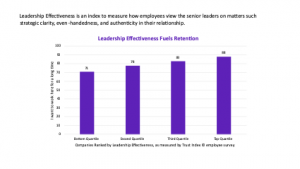
Leadership effectiveness impacts retention and innovation both:
Research done by Great Place to Work® in India shows that employees in organizations in the top quartile in leadership effectiveness have more than 20 percent higher intent to stay. (88 percent employees saying they want to stay for a long time, as opposed to only 71 percent in the bottom quartile)
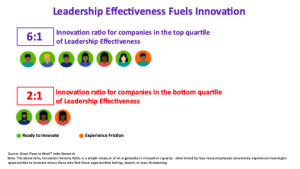
Again, in the top quartile companies, three times more employees experience consistent opportunities for innovation.
Competency Add – but culture fit is still relevant
Employees who believe that management hires people who fit in well into the culture are two times more likely to stay longer in the organization than those who do not. So, while you recruit new employees for their competencies, do not overlook culture fit.
Integrating new employees into the culture of the organization immediately upon joining is equally important.
Hybrid working has improved employee perceptions, not the other way round
Overall, employee perceptions have increased by 6 percent. This is not seen in “normal” years. What is more, areas like management’s reliability, equity, and impartiality – all difficult areas to score high on an employee survey- have gone up by more than 6 percent.
Does this mean that lack of coffee cooler conversations to discuss your boss, promotion received by someone else, or performance appraisal ratings led to an improvement in employee perceptions on lack of favoritism and politicking?
Do not discount the fact that communication has improved during Hybrid working and not deteriorated due to hybrid working. Does this partially explain why scores have gone up in the difficult areas?
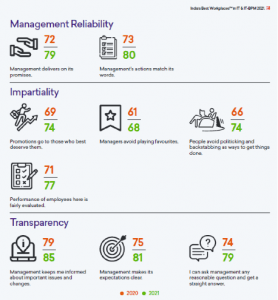
The above contradicts the belief that being together in the same office enables higher employee engagement. This would also mean that gig workers in the future who have very limited interaction with most other employees of an organization need not have lower engagement.
Perhaps, the reason why issues related to reliability, equity, and impartiality are no longer such low-scoring areas is that something else is now more important for employees.
Care, Support, and Workplace Experience are now the key differentiators between the best workplaces and the rest
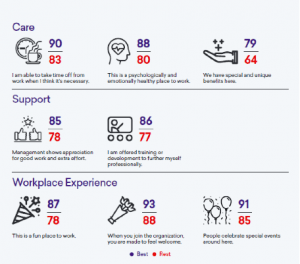
Workplace experience is not about a place anymore, yet it has got better.
In an industry where the bulk of the people are either working from home or are hybrid workers, why are more employees saying it is a fun place to work and people celebrate special events?
The answer lies in what these organizations are doing. To know these answers please wait for the annual research report of Great Place to Work® which will come out in June 2022.