


I AM TAXONOMY BUSINESS PAGE
YES I AM A DLC_COMMITTEE TAX PAGE
Committee: Design Thinking Process
Design Thinking Process Sub Committee is to seed the ‘strategy making ability’ in the new generation across all indsustries, for them to utilise tools of the design world and shift the focus on human behaviour.
Industry Leaders are betting big on leading with Design
| There’s a change in Business Leadership that’s transforming the way we solve problem and that shift revolves around design thinking. In this DLC Talks, our subject matter expert Mr. Ravindra Dolare from the Global Innovation & Design Thinking Committee speak about Why This May Be the Time for Business Leaders To Bet on Upside Growth by changing their strategy. |
Thriving in a Culture of Innovation
Shõan Shinde makes his debut in the world of podcasts as he guides the listeners through the intricate sphere of design thinking, innovation in the market, and the changing nature of the modern economy.
ARE YOU SOLVING THE RIGHT PROBLEM?
The Power of Design Thinking
How can Design Thinking be used in Public Service Organizations
We are in a time where people are not only talking about Start-up India, Aatma Nirbhar Bharat, Make in India but a lot of action around it to make India a 5trillion economy has already kick-started.
But is it enough to have a dream? An idea? To make any dreams achievable and not only achieve but also achieve at the earliest with minimum cost is equally important. India being a growing country has today identified ample entrepreneurship opportunities.
An opportunity is defined as a potential to create something new and desirable (new products or services, new markets, new production processes, new raw material, new ways of organizing existing technologies, etc.) that has emerged from a complex pattern of changing conditions. And to ensure success in business, one will need to identify an entrepreneurial opportunity that has a market.
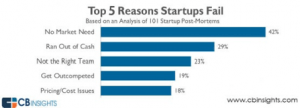
A no. of recent studies has shown that most the start-ups fail due to a LACK OF MARKET NEEDS. (Fig below). And that is where the relevance of DESIGN THINKING comes into effect.
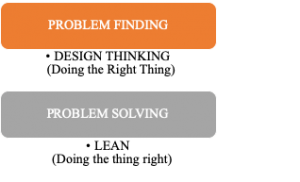
Design Thinking is a design methodology that provides a solution-based approach to solving problems.
It’s extremely useful in tackling complex problems that are ill-defined or unknown, by understanding the human needs involved, by re-framing the problem in human-centric ways, by creating many ideas in brainstorming sessions, and by adopting a hands-on approach in prototyping and testing. (www.interaction-design.org/)
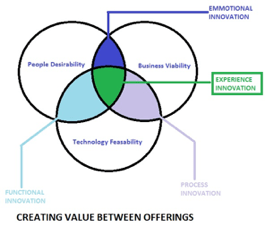 While applying the concept of design thinking into any domain of business, say public service organizations, it is imperative that we keep people at the center and ensure that it creates delight by going above fulfilling their emotional needs.
Making it just convenient by introducing new processes and functionality is generally not enough to ensure your customer keep coming back to you,
EXPERIENCE INNOVATION IS THE KEY.
For any Public service organization, the key challenge is the diversity in its customer segment, which makes the utility of the concept even more desirable. Moreover, the vulnerability of its target audience and the pressure of ensuring the success of the concept make it prudent to apply design thinking.
The easiest five-stage Design Thinking model proposed by the Hasso-Plattner Institute of Design at Stanford (d.school), helps reducing the risk of failure and ensures to give insights that make innovation more market-ready. (Fig below)
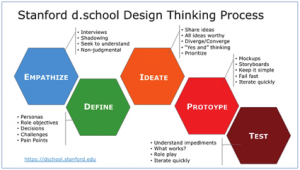
Successful innovations are defined by the intensity of collaborations with the market. It is inevitable to involve and take feedback from direct consumers while developing solutions.
7C’s of Innovation as beautifully devised by team IIT Bombay very well defines the process of Innovation using design thinking. The 7 concerns are- Cause, Context, Comprehension, Check, Conception, Crafting and Connection,
The first 3 steps- Cause, Context, and Comprehension revolve around understanding the Users. (Make efforts to study not only the primary users but Secondary and tertiary as well).
Check is about creating the checklist of the product brief to ensure that the solution promises the asks from the consumer.
Conception and Crafting are about working out on ideas and concepts and finally building prototypes and mock ups of the champion Idea.
And lastly, Connection is all about going back to the customer, taking feedback and continuing the efforts of innovating the Product/Service to ensure relevance in the changing competitive environment.
The methodology of Innovation is changing. The story of taking the product from the lab to the market has been changed to bringing the problems to the labs for successful innovations. The Sustainable Development Goals is an example of such an approach where researchers and innovators are encouraged to pick up a problem, stay close to the beneficiaries and devise solutions that are largely accepted, adopted, and are sure to create impact. For any public service organization where usually the market is big, the inclusion of and continuous intervention by all their possible categories of customer personas while innovating is crucial.
Design Thinking is iterative and the way towards successful innovation and should become a part of the culture of any organization to ensure its sustainability and growth.
Why is Empathy first stage of Design Thinking?
Design Thinking is a social problem solution method that resembles the neurological process of creativity with alternating phases of divergent thinking and task-focused thinking.
To understand the complexity of a problem, we need to diverge and look for the full set of input trajectories that help us to form a comprehensive, socially shared representation of the problem.
But of course, it is a complex system that consists of at least two nested, interdependent problems. The first problem is the one we need to understand before we think of how to solve it, the second relates to social system dynamics.
Ideally, the Empathize Phase unfolds in a psychologically safe space where all social agents share a belief, that it is safe to take socio-emotional risks and speak up, reveal their observations, thoughts and offer their evaluation in a bid to create a full information set.
Conversely, when people meet in a psychologically unsafe environment, they tend to exhibit a behavioral bias which we can call self-protection bias.
In an unsafe space, people behave passively or actively unconstructive which negatively impacts group dynamics by causing social frictions that in turn inhibit productive intellectual frictions to occur.
Rather than offering their view and diverse perspectives, they hold back and get defensive. This also creates information asymmetries as people hold back vital information conducive to understanding the problem and forming a social representation of it in a fear-based response. A misrepresentation of the problem inevitably leads to the danger that a precise solution will be found for the wrong problem and therefore, the Design Thinking process has failed!
Furthermore, perceived information asymmetries are also the main reason for unproductive conflicts in social systems leading to adverse emotions.
Individual emotions are contagious, and they spread fast through the entire social system. Especially, negative emotions are highly infectious and stick around for a while. Apart from individual and social levels of emotional inertia, social system trajectories are path-dependent. What happened back then influences perceptions and interpretations in the present and has implications for expectations about the future, which feeds back to the current experience and subjective reality.
This is problematic for all other stages of the Design Thinking process such as ‘Ideation’, where everyone is asked to think creatively and share their ideas through sharable abstractions.
Creative thinking is based on the ability to switch between task-focused thinking which predominantly occurs in the left hemisphere of the brain and the right hemisphere-focused default mode network [DMN], which is active when the task-focused network is suspended. The DMN is active in daydreaming and responsible for moments of serendipity, a much-needed trait in Ideation.
When we are stressed out because we are moving in a space of socio-emotional stress, our self-protection needs become salient, and emotional processing centers in the sub-cortical regions shut down our task-focused cognitions and inhibit the DMN to be productive in the sense of creating ideas for the problem subject to the Design Thinking process.
Thus, the Empathy Phase goes way beyond understanding the problem that needs solving.
To create a psychologically safe space, people need to feel actively listened to without having the feeling of being judged or disrespected for who they are or what they say.
The most important start for the Design Thinking process is to do exactly that – empathize cognitively by joining the other peoples’ mental model of the world which creates their subjective reality of the problem and to empathize emotionally, trying to understand how they feel about the problem and develop compassion for all stakeholders.
This gets you the best of information in terms of quantity and quality and sets the social system up for a successful Design Thinking process.
Conversely, a Design Thinking process that starts in a psychologically unsafe space will be inefficient, ineffective, and entirely futile.
Education in the near Future.
Using Design Thinking to redefine Customer Experience
What is Design Thinking?
Alessandra who has a diverse experience in Luxury, FMCG , Fashion, Textile Manufacturing, and Housewares across the world. Watch how Alessandra who is a regular practitioner of Design Thinking , uses it to run his expertise parallelly across all these domains. He will reveal the basics of Design Thinking and how this unique strategy making process can be applied in all industries, followed by benefits of it and real life examples.