


Amidst the unpredictability of the world economy which was a result of the prolonged Covid-19 pandemic, the current work environment in organizations worldwide needed to be adapted and transformed. Under the Thai government’s administration, measures to prevent and tackle the outbreak were imposed in 2020 among which were lockdowns, minimized travel, limited group activities and work from home policy. In response, corporate leaders were compelled to adjust their work behaviours and shift from face-to-face meetings to online meetings while working from home.
Aside from the pandemic, technological changes also play a critical role in business operations today. Bangkok Life Assurance PCL decided on its strategies titled Change for the Future and Go Beyond the Limit a few years ago with the aim of driving the organization to stay abreast of technology development and be ready for sustainable business evolution. The management and human resources planning are, thus, more significant than ever. The Company is thriving to develop all leaders, successors and talented individuals across the organization as its priority to prepare for any future challenge.
In this regard, Leadership is crucial when it comes to preparing for management in any situation which may arise. This is so that the management can plan and solve the problems together. At the Human Resources Management Department, we began by establishing a foundational leadership model to formulate appropriate current leadership competencies which need to be strengthened and developed to achieve organizational objectives as well as to increase customer confidence in sustainable management.
In the past three years, we have had the opportunity to revisit and lay the foundation for human resources management in various HR core grounds. Significantly, development in the areas of leadership, succession planning and talent management has been at the forefront of our focus which includes a concrete plan for learning and
leadership development i.e., performance improvement program (PIP) and individual development plan (IDP). All of this is done to ensure that our successors and talents are ready to fulfil the vacant positions appropriately. We also believe that internal talent and nominated successors are identified as human assets for the Company. We aim to fill their competency gaps through the scheme designed specifically for succession planning with the linkage to promotion or replacement in positions as well as backed by the compensation package.
The implementation of plans and strategies in leadership development has created benefits and values in the following three key dimensions:
– Employee dimension
– Departmental dimension
– Organizational dimension
Keeping a lower percentage of talent resignation measured by the B grade and above is one element of HR KPIs. Thus, HR acts as a bridge between the needs of human capital and executives by focusing on talent management – given that talent is the ultimate differentiator between companies, products, and services. HR, therefore, becomes the significant protector of the talent group to keep them working in the company as long as possible.
Bangkok Life Leadership Competency, which is achieved through the cooperation of the executives in participating workshop by considering Bangkok Life’s DNA Leadership and obtaining Leadership Competency in all six areas which are Visioning, Decision Making, Change Management, Managing and Developing People, Communication and Business Innovation.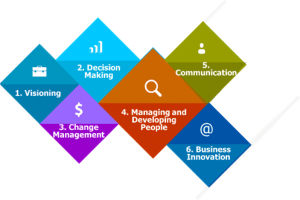
The Company has established competencies at various levels with the objective to be used to measure the knowledge, skills and behaviour of employees in accordance with
the goals and standards of the organization by competency evaluation which is one of the components of the annual performance appraisal that is used as a tool to assess the potential of leaders in the organization, individual development plan: IDP- to develop knowledge, skills and competencies to be able to work effectively.
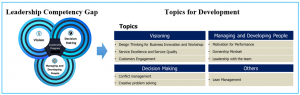
In 2021, HR has designed the Leadership Development Program together with a well-known university based on leadership competency gap results as seen in the following sample topics. The course takes around two or three months with the certificate provided on the ceremony day.
Sample of Leadership Competency Gap and Topics for Development
Nevertheless, Leaders should keep their knowledge and skills up-to-date to gain better performance across departments and organisational KPIs. This is because leaders are the key people who need effective management and coaching skills as a mentor of their subordinates. Therefore, we are determined to foster strong leadership skills to build talented organisations that can move at the pace of today’s business and help shape the new world of the workforce effectively.
 First and foremost, the corporate world needs to introspect whether they want to talk about Diversity only ‘to appear right’ or they truly believe in ‘being right’. If it is the latter, then diversity alone is meaningless, we need to be inclusive in our approach. For example, even if we hire a diverse workforce, what is more important is how ‘inclusive’ are we towards people with different gender, abilities, thoughts, beliefs, viewpoints, ethnicities and many more. Without inclusion diversity has no relevance. Therefore, before we even make diversity as an initiative in corporates, there is a need to have an inclusive mindset. How many of us are willing to accept a person who is with ‘special abilities’ as a Manager , or for that matter from a ‘different gender’. Do we welcome different viewpoints from our peers or our team members or do we stereotype them? How true are our intentions towards taking initiatives around diversity? The leadership needs to first and foremost have genuine and true intentions towards diversity and inclusion and win the trust of the entire organization by ‘walking the talk’. To my mind, this is the STEP ONE and needless to say that STEP ONE is the most difficult one and is the biggest milestone. Once this milestone has been achieved, the rest of the journey becomes a lot more seamless. This journey can be instrumental in the organization turning from ‘Good’ to ‘Great’.