


I AM TAXONOMY BUSINESS PAGE
YES I AM A DLC_COMMITTEE TAX PAGE
Committee: HR Consultants
Human Resource being the most valuable asset the key to managing their experiences is an integral part of an organisation’s success. DLC brings together industry stalwarts with extensive understanding of workforce transformation strategies which helps organizations drive productivity and meaningful change.
The Great Resignation as the Great Career Revival
The idea of the Great Resignation originated in the United States and was proposed by Texas A&M Professor, Anthony Klotz. It proposed the observation of a phenomenon that is happening now with record numbers of people leaving their jobs as the COVID19 pandemic continues to unfold. Rough estimates suggest that 33 million Americans have quit their jobs since the spring of 2021.
Specific observations on the Great Resignation included the following:
- The resignation seems to occur most among mid-career workers
There is greater demand for mid-level workers due to their experience. This gives mid-career types greater leverage in securing employment opportunities.
- The highest rate of resignation is happening in technology and healthcare
Resignation rates among workers in these sectors are attributed to high demands and the experience of significant stress which have resulted in increased workloads and burnout.
- People are placing a priority on their health and well-being
Many workers have reached a breaking point after months of high workloads, hiring freezes, work pressures and the absence of proper work boundaries and respect for personal time. These factors have caused many to rethink their work and life goals. Many are opting for greater focus on their health and well-being.
What has it taught us?
What the pandemic has certainly taught us is that things are not expected to return to normal as people and organizations have been forced to rethink the very notion of work. It heralded Future of Work conversations in an unprecedented way. Hybrid, remote and working-from-home have all become permanent features of the New Normal. In fact, the phenomenon is still playing out as experts have yet to see the full extent of what a post pandemic workplace will look like. One thing is for sure – organizations will need to move away from any one-size-fits-all approach to managing the challenges of onboarding, developing and retaining talent in a post pandemic world in a far more novel way.
A clear outcome is that people have many choices now. Employees who are self-motivated and willing to assume greater agility and control over their careers have discovered that it was possible to do so at a much greater rate of participation than ever before. They look for opportunities which allow for that agility to be expressed in the way they desire, and more importantly, at their time and pace.
Conversely, the pandemic has also caused a significant mental toll. In a study by the American Psychological Association, “Stress in America”, it found that 32% of adults were stressed by the pandemic and even to the point of dealing with daily routine decisions such as what to eat or wear.
What has it taught organizations?
The idea of centralized leadership is being challenged by a more fundamental shift towards self-leadership. In the war for talent, successful organizations have turned their focus on people in a big way. More than ever, they understand that the emphasis has to be on empowering workers, making permanent flexible work arrangements permanent, putting in place health and well-being programs, having blended workforce solutions, investments in technology and artificial intelligence, and last but not least, building a culture of trust. In essence, the key is “having work fit around personal lives and not personal lives around work” (Anthony Klotz).
It is actually an opportunity to herald the Great Revival
In my survey of the vast literature out there on the topic, I have arrived at the following 4 Eureka moments:
- The Great Resignation is not mainly about compensation anymore. Virtual and remote work is here to stay and people are exercising greater control and flexibility over their lives.
- The strongest predictor of staff turnover is a toxic culture. Failure to demonstrate respect, promote diversity and inclusion, focus on equity and unethical behavior will further drive up the Great Resignation.
- Failure to recognize performance and value will drive your better performers to quit and seek greener pastures.
- Response to the pandemic and having a clear vision of the future which motivates and inspires. Leadership plays a critical role in setting the right tone in visibly demonstrating competence during a crisis, and at the same time, raising the bar when it comes to looking after their most prized assets – their human capital.
73 Questions with Dr. Gaurav Buch
73 Questions with Abigail Wilmore
Matter of Survival : Grow or Sustain
Grow or sustain?
One of the biggest dilemmas for all the organizations in the current year has been the balance to focus between growth & sustenance. While the pandemic resulted in outraging opportunities in the knowledge industry, the same year also counted for circumstances like the Great Resignation. The ripple effects were also witnessed in the connected industries like automobile, real estate, etc as the spending ability spiked disproportionately. Also, the shortage of quality manufactured products due to the shut down in the previous year further created a gap in the demand-supply chain.
Two paradigm shifts in last year – first the organizations trying to curtail the cost to secure margins and consequently downsizing. A so-called recession at the start of a pandemic or we should say an effort to predict with a pessimist view led to the fright of recession. However, towards the end of FY 21, an absolutely reverse effect started influencing the market which was unprecedented. Unlike the pessimistic view, this was growth. While the futurist predicted recessions after every decade, the same played an important role as the masters were waiting for it since 2018.
The most interesting events that took place during the last two years:
- The strategy of employee focus:
This was a radical change as Trust between the employee & employer became the most important factor for delivery. The traditional approach of monitoring working hours was broken in the blink of an eye. Now the trust has to be redeployed which resulted in failure for taskmasters and reverse stress was generated. Initially due to balancing the work-life with less workforce to secure margins and later due to gap created by longer recruitment cycles as competition brought in enormous challenges. The only successful leaders from this era were the ones who demonstrated a high level of resilience and who could think of new ways to inspire people. Pragmatically, the intimidating leadership demised and the inspiring leadership could sustain. One more key distinguishing factor of the good leaders in this era was also multi-tasking. The leaders who could clearly make business predictable amidst both the chaos. One by planning more and second by preparing the teams for the upcoming times by understanding the pointers to bring unprecedented scenarios under the remit of predictability. They were firm on that one age-old basic – Predictability is proportionate to sustainability
2. Parity and cost arbitrage:
One of the most difficult task in the last two years for entrepreneurs and intrapreneurs were to balance the internal parity Vs the cost arbitrage. While the sound of it says that it should have impacted only the outsourcing industry, however when one thin sliced the situation, its influence is observed on every business owner. While the leaders in the west wanted to outsource more to ensure faster recovery due to pandemics, the leaders in the East were struggling with the rise of direct cost impact due to competition. I’m sure that we have answered questions on this either in front of the CXOs or the board of directors. Here I could observe a very contradictory proposition here. While all the leaders were pessimistic about the circumstances, the positioning was always optimistic. Few examples are like comparing the nos with pre-pandemic and saying we are almost there and recovery will be faster here onwards, SG&A cost has been increased for now for better focus on governance which can be curtailed as we go back to the office, etc
In short, all the questions had a pessimistic approach, and the answers had an optimistic tone. While this is the common tactic in all complicated board meetings to ground-level reviews, what’s intriguing was everyone knew the market scenarios which were challenging and most often termed as unprecedented. These challenges were location agnostic and business agnostic as the world went through it simultaneously with a minor lag from country to country.
I remember that when the lockdowns started in India, Ratan Tata was the only business leader who demonstrated optimism while the other generated hue and cry. He was the one emphasizing taking care of people in losses and they will help you to retrieve success stories once they understand how the organization has sustained through difficult times. Today, on one hand, corporate houses want to grab the growth opportunities which are available in abundance and on the other hand regret the retrenchments and conservative approach taken during the first phase of pandemic
This underscores an important point that while investing one must identify the price of success – volatility & loss amid the long backdrop of growth and be willing to pay it!
73 Questions with Sabrina Moore
Leadership in Today’s Workplace
Amidst the unpredictability of the world economy which was a result of the prolonged Covid-19 pandemic, the current work environment in organizations worldwide needed to be adapted and transformed. Under the Thai government’s administration, measures to prevent and tackle the outbreak were imposed in 2020 among which were lockdowns, minimized travel, limited group activities and work from home policy. In response, corporate leaders were compelled to adjust their work behaviours and shift from face-to-face meetings to online meetings while working from home.
Aside from the pandemic, technological changes also play a critical role in business operations today. Bangkok Life Assurance PCL decided on its strategies titled Change for the Future and Go Beyond the Limit a few years ago with the aim of driving the organization to stay abreast of technology development and be ready for sustainable business evolution. The management and human resources planning are, thus, more significant than ever. The Company is thriving to develop all leaders, successors and talented individuals across the organization as its priority to prepare for any future challenge.
In this regard, Leadership is crucial when it comes to preparing for management in any situation which may arise. This is so that the management can plan and solve the problems together. At the Human Resources Management Department, we began by establishing a foundational leadership model to formulate appropriate current leadership competencies which need to be strengthened and developed to achieve organizational objectives as well as to increase customer confidence in sustainable management.
In the past three years, we have had the opportunity to revisit and lay the foundation for human resources management in various HR core grounds. Significantly, development in the areas of leadership, succession planning and talent management has been at the forefront of our focus which includes a concrete plan for learning and
leadership development i.e., performance improvement program (PIP) and individual development plan (IDP). All of this is done to ensure that our successors and talents are ready to fulfil the vacant positions appropriately. We also believe that internal talent and nominated successors are identified as human assets for the Company. We aim to fill their competency gaps through the scheme designed specifically for succession planning with the linkage to promotion or replacement in positions as well as backed by the compensation package.
The implementation of plans and strategies in leadership development has created benefits and values in the following three key dimensions:
– Employee dimension
– Departmental dimension
– Organizational dimension
Keeping a lower percentage of talent resignation measured by the B grade and above is one element of HR KPIs. Thus, HR acts as a bridge between the needs of human capital and executives by focusing on talent management – given that talent is the ultimate differentiator between companies, products, and services. HR, therefore, becomes the significant protector of the talent group to keep them working in the company as long as possible.
Bangkok Life Leadership Competency, which is achieved through the cooperation of the executives in participating workshop by considering Bangkok Life’s DNA Leadership and obtaining Leadership Competency in all six areas which are Visioning, Decision Making, Change Management, Managing and Developing People, Communication and Business Innovation.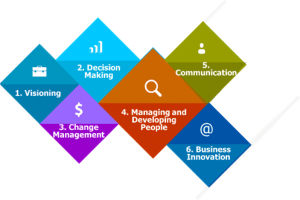
The Company has established competencies at various levels with the objective to be used to measure the knowledge, skills and behaviour of employees in accordance with
the goals and standards of the organization by competency evaluation which is one of the components of the annual performance appraisal that is used as a tool to assess the potential of leaders in the organization, individual development plan: IDP- to develop knowledge, skills and competencies to be able to work effectively.
In 2021, HR has designed the Leadership Development Program together with a well-known university based on leadership competency gap results as seen in the following sample topics. The course takes around two or three months with the certificate provided on the ceremony day.
Sample of Leadership Competency Gap and Topics for Development
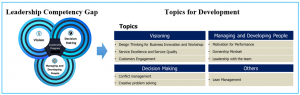
Nevertheless, Leaders should keep their knowledge and skills up-to-date to gain better performance across departments and organisational KPIs. This is because leaders are the key people who need effective management and coaching skills as a mentor of their subordinates. Therefore, we are determined to foster strong leadership skills to build talented organisations that can move at the pace of today’s business and help shape the new world of the workforce effectively.
Key factors influencing the loyalty of the employee
Mr. Gosh takes the listener through one of the most paramount goals of an organization: earning the loyalty of their respective workers. Mr. Gosh shares his acquired knowledge, spanning over 20 years in the field of HR, in the form of this podcast and urges the listeners to develop and curate habits and practices that generate unflinching loyalty.
Take a stroll through this 5-parter podcast and learn the ways to retain and create talent and optimal output.
Tips to how HR can Motivate and Engage New Hybrid Workforces post Covid.
The pandemic has made the professional world more challenging than ever. With the backdrop of a more unstable workforce, organizations are realizing the value of efficient employees more than ever. With all the uncertainty and dynamism in the air, HR professionals are indispensable now.
Companies have had to tirelessly innovate the organization structures to accommodate changes. Due to frequent separation of employees, workflows have had to be redefined and manpower planning has become more complicated. Job descriptions have evolved and become more fluid, making recruitment more challenging amidst a shrinking budget. Given the current state of things, it is imperative for companies, both large and small, to focus on employee retention. Onboarding and building a sense of belonging in any new hire’s mind cannot be done through conventional means anymore. Earlier, the infrastructure of offices in itself played a role in engaging new employees. But now, HR is forced to think outside the box.
One of the contemporary innovations is the hybrid working model, which combines both working from home and working from office. This has the potential of being both a boon or a bane, depending on the implementation. HR professionals have been brainstorming, ideating and endlessly improvising to ensure a committed and uninterrupted workforce. The crucial thing here is striking the right balance and enabling the transformation, both physically and psychologically. If and when employees are coming to offices, HR needs to plan what number of employees need to be available at the same time and at what intervals. Policies for this would range from planning the transport to understanding which employees are interdependent on each other. One common model evolving is where localites are being called to work first and people from out of station are being given the option to report to their nearest branch instead of one fixed branch. Even attendance policies have had to be reframed to define how many hours an employee has to spend at work. Productivity patterns have reformed a lot. After employees have worked from home for all these months, it will be difficult for them to sit at their desks and be continuously productive for hours at a stretch in office, especially in a hybrid model where working from home will still be in the picture. Policies to accommodate small regular breaks while working would need to be put in place. Plus, more attention needs to be paid to employees’ families, since schools are not operating like they used to.
One of the greatest weapons in an HR’s arsenal used to be recognition. However, not only is it more difficult to measure performance now, it is also more difficult for keep everyone updated with their peers’ accomplishments. Performance review policies need to be restructured to identify key performers. KRAs and KPIs must now be aligned with the new working model. With roles becoming more fluid and open ended, career objectives are also becoming multi-dimensional. A simple “Employee of the Month” is no more sufficient. Matrices to measure intangible contributions such as leadership skills need to be developed. This can be done by asking leading questions, communicating more often, and structuring rewards accordingly.
Communication policies too need to be redefined to make sure loyalty is built amongst the employees. Certain organizations have come up with virtual “water cooler” channels wherein employees can have informal communication in office hours. These channels are crucial for maintaining the balance. Periodic automated feedback, HR Skip meetings, monthly self-appraisal, are all some simple ways of implementing formal communication channels.
The most basic requirement of a hybrid model would be to blur the boundary between office and home. The comfort level at offices will have to be increased to make the frequent switches in work environment friction free. Actions for this could range from something as simple as putting more comfortable chairs in offices, to something as complicated as being focused on the output rather than work hours. However, that said, it is also essential to value work-life balance. Employers must realize that covid-anxiety is real and going forward, mental health needs to be factored into decision making.
The beginning of the pandemic witnessed a global recession with millions losing their jobs. But now that the world is slowly accepting the new normal, we are seeing what is being called “The Great Resignation” or “The Big Quit”. America saw as high as 4 million resignations in a single month (April 2021). Europe too has faced resignations from over 6% of its overall working population in some major economies like France, Germany, UK, Belgium, etc. China is facing a similar phenomenon. It is all due to a dissatisfied and displeased workforce. Employees are wary of joining an organization which may resort to lay-offs when crisis hits. Even MNCs like Microsoft and Apple are spending millions to retain talent. The only way to manage all this change is to give credit where credit is due. Value the invaluable role that HR plays in any organization and start acknowledging that human capital is the most expensive and potent one there is.