Earlier this year, on the 20th of March, we were informed that it was World Happiness Day. While I’m not much of a fan of such man-made ‘days’, this was a day I welcomed, given the state of affairs that the whole of humanity has been grappling with for more than a year now.
Writing on happiness is tricky. Because it’s subjective. And fleeting. And externally located. In other places & other times, to be arrived at only at a point in the future, by accomplishing this or that.
But let’s try anyway. And also, let’s talk of Joy. . What’s the difference? Well, if happiness is content, Joy is the space in which it comes and goes. If happiness forms, Joy is the essence that holds it. If happiness has a polar opposite in unhappiness, Joy has none. In short, Joy is our natural state of being, often clouded by events & circumstances that we take too seriously as we go about playing life.
As you grow older, you realize that Joy is beyond hedonism or eudemonia. You also realize that Joy is not a mysterious & profound destination, but resides in the holy ordinary.
Let’s get into it, shall we ? Here’s my A-Z on discovering Joy. Written at intermission ( past intermission, actually 😊 ). Some days I chase it & catch it. On other days, it tries to catch me, but fails.
A – Amor Fati. Or love for fate. Meaning, accepting your life situation as is, without labeling it bad or good. Sooner you start believing that whatever happens, happens for a reason & that in the end everything is balanced & part of a Higher order, the better ( Quick fact byte – Cosmos means Order, the opposite of chaos).
B – BE. Yes, it sounds simple, but takes effort. Just BE. We’re called Human Beings for a reason ( instead of Human ‘Doings’).
C – Control & Choice. To paraphrase the Serenity prayer – Let’s have the serenity to accept things we cannot change, the courage to change what we can & the wisdom to know the difference. And yes, trying to control anyone else is a dumb idea & a definite Joy- dampener.
D – Die a little every day. Unless you shed the past, you cannot let Joy breathe. True Joy is the realization that death is not the opposite of life, but it’s the opposite of birth. Birth & death are two repetitive events in the infinite march of Life.
E – Enthusiasm, derived from the Greek word, Entheos, means the God within. How will you find Joy in what you do if you do not let the Dude handle it for you ?
F – Failing & Failure are different things, and not to be confused with each other. You need to fail often to know what works & what sucks. Just do not fail at the same thing too many times. Failing & yet knowing that you’re not a failure, is what Joy is about.
G – Gnothi Seauton. Meaning ‘ know thyself’. This Ancient Greek aphorism is one of the Delphic maxims inscribed in the pronaos of the Temple of Apollo at Delphi. Happiness is knowing yourself as others know you or getting them to know you as you wish to be known as. Joy is knowing yourself as you are. No more. No less. No apologies.
H – Here ( & Now), is all that you have to experience Joy. The rest of it is either an illusory Past that you peer back at in search of an identity & an imaginary future you look forward to in anticipation of some salvation.
I – Inwards. The most joyous journeys lead home.
J – Jnana. In Sanskrit, it roughly translates as an event that’s understood only when experienced. It is the wisdom that’s attached to the total experience of reality, especially a total or divine reality. In Tibetan Buddhism, this means pure awareness that is ‘free of conceptual encumbrances’. Sounds like the Joy we’re talking about, right ?
K – Karma exists, so I suspect. Even our most secret & innermost thoughts are reported, and accounted for. Keep them clean. Karma & Joy are either the best of friends or worst of enemies. You choose.
L – Let go. Love like a verb ( especially when Love, the noun, is on vacation). Laugh like a child. Listen with all your senses – not to respond, not to understand, but only to listen.
M – Your Mind. Is a very powerful tool. But still, only a tool. Do not turn it into your identity. True Joy is the ability to refer to the Mind when needed, and letting it snooze at all other times.
N – Non-resistance is the way of Joy. More you resist something, more you strengthen it. Let life flow.
O – Om. Atman. The soul within. The Divine Center. Where it all begins, and ends. Be in touch with it often. And you’ll laugh aloud when you see all the drama around, in pursuit of happiness.
P – Perfection is overrated. You were not meant to be perfect. Nobody was. You were just meant to be you. The best version of you. Phew !
Q – Que Sera Sera. Whatever will be, will be. You’re but just a speck of dust on a grain in the palm of infinity. Stop taking yourself so seriously.
R – Reflection. Yes, the orifice through which life unfolds for you, is but only an exact reflection of what you send out. Therefore, you’re actually never experiencing anything externally but your own inner world on the mirror of life.
S – Silence is the language of God , all else is poor translation. Rumi nailed it. Whenever possible, withdraw into your silences. They are always telling you something that leads to Joy.
T – Trust. Always start with trust. At least, if you start with trust and get duped, you won’t be guilty of not having done your bit. Starting with distrust & still getting duped is a double whammy.
U – The Universe is objectivized thought, disguised as matter & circumstances. Choose your thoughts well. Joy will show up. And keep showing up.
V – Vipasaana. Okay, you need not get all nerdy about meditation techniques to unlock Joy in your daily life. Just step behind your monkey mind as often as you can, and catch it as it keeps swinging between past, future, fiction & anticipation. It’s a fun activity. You’ll re-discover the You who you left behind. At misty bends & messy ends.
W – Wu Wei. Taoism defines it as the art of inexertion or inaction. When you need to reach someplace fast, try slowing down. When you need to win at something, stop competing.
X – Xenophobia ( Yayy, I found a word with X !) – is stupid. And a Joy killer. Accept people as they are. To each, his own, her own. Everyone out there is a little messy & a little broken. Just like you. Just like me.
Y – Yesod. According to Jewish Kabbalah, this is the foundation upon which God built the world. While I love the word & plan to read more on it, it reminds me of what we call ‘Chi’ in the east – the energy field that bridges the external reality with the Source within. Joy is the ability to stay connected to that field as often as possible. Not easy, by any means. But worth a try.
Z – Zen. Of course. The state of ‘No-Mind’, or a mind attached to no concept or opinion or emotion. The gaps hold the cage. Ultimately, Joy is being one with the gaps. The cage will come & go.



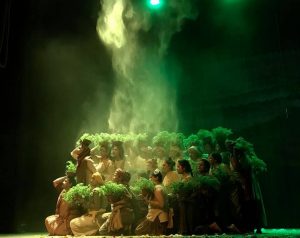 Engaging in Arts sharpens our senses and we develop a heightened sense of observation and empathy towards ourselves, others, and the environment. As an actor/director and facilitator, working in the field of Theatre for the past three decades, I have seen the efficacy that Theatre brings in people’s lives. While training students across the whole spectrum of age and gender, I have realised that they all felt Theatre was their medium of reckoning themselves to become independent, confident, and holistic individuals. Theatre helped them shape their path of career choice, grow as better individuals, achieve creative perspectives of imagining, and discover methods to live a balanced lifestyle. Theatre is a magic wand that enhances creative thinking. The improvisation techniques in Theatre motivate one to think in the most dynamic way using various cross-sector approaches and also encourage one to widen their scope of observing and responding.