I AM TAXONOMY PAGE

How Employee Volunteer Programs Can Improve Your Company

Encouragement and promotion of employee participation in community programs is one way for businesses to demonstrate their social responsibility. Employer programs that aid and support employees in volunteering, in particular, are gaining popularity. Employee volunteering, also known as corporate volunteering or employer-supported volunteering, allows employees to volunteer in their communities while receiving active support from their employers through both formal and informal policies and initiatives.

Employee Volunteer programs have been proved in numerous studies to promote productivity, employee engagement, and hiring and retention. According to a study published in 2013 by  Harvard Business Review, the more employees who volunteered (even if it was on their own time rather than on business time), the better they did on job duties. It was also revealed that volunteers, at work, tended to be better citizens (helping others, voicing ideas, and so on).

Structuring an Effective Employee Volunteer program:

You are sure to come across a variety of corporate volunteer programs. Some companies allow employees to volunteer for a cause or activity of their choice, while others organize highly structured events for teams to participate in together, such as a charity run, etc. Here’s how you can design an EVP that is best suited to your organization.

  1. Begin with the vision and mission of your company.

Setting up programs that align with your values is an effective method to demonstrate to your shareholders, customers, and employees that you adhere to certain values and that you act on them.

When you’re deciding on your fundamental program concepts, be as open and transparent with your team as possible about why you’re doing it. This will assist in removing any cynicism. Demonstrate to your employees that they can rely on you for assistance in living lives that are driven by a higher purpose.

  1. Choosing the causes your organization will support.

There are a few ways for determining which cause to support. This can be decided in a top-down hierarchy, with upper management selecting the causes. You might also conduct a survey or speak with your employees to understand the kinds of causes they wish to support or are already supporting. The best approach is usually a mix of the two: you may have certain central campaigns focused on the causes required by upper-level management, while also encouraging your employees to decide what causes they want to support on a local and global level. Either way, make sure you have a clear understanding of why you’re supporting the causes you do.

  1. Set clear objectives

The key to creating a successful corporate volunteering program is to set clear and quantifiable goals. Consider how your program’s objectives fit into your company’s overall strategy and develop metrics to help you turn these aims into measurable accomplishments.

Keep your resources in mind while you set your goals. Answer questions such as – how much time do you think you’ll be able to devote to this? What is your financial plan? Etc. Implementing a best-in-class corporate volunteering program is a process; you may begin with a few projects and gradually expand your program to include more possibilities for your employees to participate and maximize your effectiveness.

  1. Find an employee volunteering platform to partner with. 

Employee engagement is boosted by an online platform because it allows employees to join in from anywhere and track projects in real-time, even if they work remotely. It makes volunteering easy for your employees by bringing alternatives to them.

Online volunteering offers a lot of advantages such as –  your employees can access and browse from a catalog of projects, you can centralize and manage the entire program from one location, and you can track the impact your program is making, and share the results with the entire company to prompt others to come on board. A partner will be able to assist you in identifying appropriate causes that are in line with your company’s beliefs.
The urge to discover the Real Essence of life

Listen to Anshul Bafna’s insights on spirituality, self-awakening to understand the true essence of life and unrevealing each chapter of their life. Anshul Bafna shares her experience of her journey on a DLC platform. how It’ll help them professionally, if they want to become a successful entrepreneur or lead the business, professionally help someone, or provide aid to the need

How essential oils brings heritage to modern day living

How essential Oils brings heritage to modern-day living 

 The world is taking brave new steps towards a sustainable future. In other words, nature is taking over. Some might say that the essence of today’s modern-day living finds its heritage in essential oils. In our contemporary living rooms decorated in elegant themes and fancy furniture, essential oils are the traditions that bring us closer to our roots and to ourselves.  

 As we know, the first records of essential oils come from Persia, Greece, Egypt, Rome, and of course, India. While we and the Egyptians, Greeks, and Chinese used these oils for ritual and healing purposes, aromatherapy using these magical potions was first used in Cleopatra’s land, Egypt.   

 Eoils brings a slice of royalty with them in today’s modern-day living: 

 In India, essential oils have played a special role. In the kitchens of royal households was the secret weapon of the healers of that time – pure essential oils. Ayurveda has a 3000-year-old history that would tell you about the goodness of eoils in healing. 

According to Ayurveda, essential oils have the power to balance our emotional states and ultimately lead to our overall well-being. Rose, for instance, has been a favorite ingredient of the royal kitchen for ages. Earlier, people used to take aromatic rose baths to feel rejuvenated. Not to forget it was Queen Cleopatra’s favorite.  Rose has also been a forever favorite amongst aromatherapists. The oil stimulates the release of the chemical Dopamine. The chemical that can lower depression levels. Rose oil has antibacterial properties. When inhaled, it regenerates the skin and rejuvenates tired muscles. Essential oils like Rose bridge the gap between traditional and modern and give us a path for a better lifestyle. Rose gardens were more than a scenic view, they were royal secrets. This is also true for oils like Sandalwood. What we at Wikka do is take that traditional wisdom and fuse it with modern techniques and ways for better skin health and overall give a sense of healing all around.  

 Where should you start as a beginner: 

 The quest for finding the perfect essential oil is never-ending. It is especially overwhelming for beginners. So if you are new at this, there are a few tricks that will help you understand aromatherapy better and use it well to liven up your spaces.  

 1. Essential Oils need carrier oils – Essential oils are heavy. Diffusing or applying them directly are never the best options. Always use a carrier oil.

2. Buy only pure essential oils – As I said, Rose has been a part of our traditions but it is difficult to get pure extracts today simply because it is expensive and you can get all kinds of adulterated versions. Choose only trusted brands for your essential oil needs. People who are dealing exclusively in essential oils and natural products will give you the purest concoctions. At Wikka, we are constantly improving the beauty game by bringing natural products under the spotlight. Essential Oils are the products on which we built our legacy.

3. Don’t start mixing right away – An experienced aromatherapist can help you mix the best blends for your home and suit your style. However, it is difficult to do it on your own. Always consult before mixing essential oils.

 What we are doing at Wikka 

 Wikka is a luxury natural beauty brand. We specialize in holistic healing. A very important part of our journey has been healing clients who dealt with severe physical and emotional problems, through aromatherapy and natural products. Through our pure and exotic essential oils, we have accelerated the process of healing in so many individuals. We started from essential oils and stumbled upon the need for natural beauty products. After we crafted a beauty line of our own for skin, body, and hair health, we moved towards fragrance solutions. Currently, Wikka is providing the best fragrance solutions across the world.  

 Modern-day living is not just a model of a perfect home and lifestyle. It is blending luxury and science to heal the most complicated problems of our times. It is living life in the best ways we know. It is healing through nature, and essential oils, by all means, bring heritage to it. 

What is shifting in the workplace culture?

The 2- Dimensional employee: 

Many young, new employees are leaving soon after joining. Often referred to as “infant mortality”, this number is going up. This is only a footnote in the published literature on “Great Resignation” or “Great Reset”. 

“I know all the people who have joined in the last two years only in two-dimension, over video calls. How do leaders build trust with employees you have not met in person?” asked the CEO of a technology company. 

And yet Leadership has never been more relevant. 

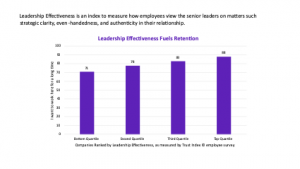
Leadership effectiveness impacts retention and innovation both: 

Research done by Great Place to Work® in India shows that employees in organizations in the top quartile in leadership effectiveness have more than 20 percent higher intent to stay. (88 percent employees saying they want to stay for a long time, as opposed to only 71 percent in the bottom quartile) 

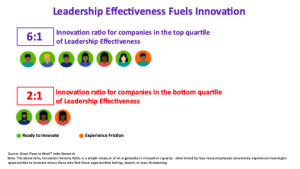
Again, in the top quartile companies, three times more employees experience consistent opportunities for innovation.

Competency Add – but culture fit is still relevant

Employees who believe that management hires people who fit in well into the culture are two times more likely to stay longer in the organization than those who do not. So, while you recruit new employees for their competencies, do not overlook culture fit.

Integrating new employees into the culture of the organization immediately upon joining is equally important.

Hybrid working has improved employee perceptions, not the other way round

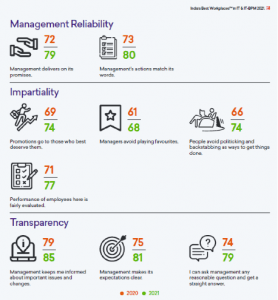
Overall, employee perceptions have increased by 6 percent. This is not seen in “normal” years. What is more, areas like management’s reliability, equity, and impartiality – all difficult areas to score high on an employee survey- have gone up by more than 6 percent.

Does this mean that lack of coffee cooler conversations to discuss your boss, promotion received by someone else, or performance appraisal ratings led to an improvement in employee perceptions on lack of favoritism and politicking?

Do not discount the fact that communication has improved during Hybrid working and not deteriorated due to hybrid working. Does this partially explain why scores have gone up in the difficult areas?

The above contradicts the belief that being together in the same office enables higher employee engagement. This would also mean that gig workers in the future who have very limited interaction with most other employees of an organization need not have lower engagement.

Perhaps, the reason why issues related to reliability, equity, and impartiality are no longer such low-scoring areas is that something else is now more important for employees.

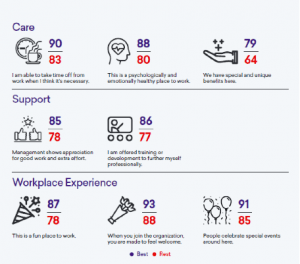
Care, Support, and Workplace Experience are now the key differentiators between the best workplaces and the rest

Workplace experience is not about a place anymore, yet it has got better.

In an industry where the bulk of the people are either working from home or are hybrid workers, why are more employees saying it is a fun place to work and people celebrate special events?

The answer lies in what these organizations are doing. To know these answers please wait for the annual research report of Great Place to Work® which will come out in June 2022.

Happiness, the A – Z of it

Earlier this year, on the 20th of March, we were informed that it was World Happiness Day. While I’m not much of a fan of such man-made ‘days’, this was a day I welcomed, given the state of affairs that the whole of humanity has been grappling with for more than a year now.

Writing on happiness is tricky. Because it’s subjective. And fleeting. And externally located. In other places & other times, to be arrived at only at a point in the future, by accomplishing this or that.

But let’s try anyway. And also, let’s talk of  Joy. . What’s the difference? Well, if happiness is content, Joy is the space in which it comes and goes. If happiness forms, Joy is the essence that holds it. If happiness has a polar opposite in unhappiness, Joy has none. In short, Joy is our natural state of being, often clouded by events & circumstances that we take too seriously as we go about playing life.

As you grow older, you realize that Joy is beyond hedonism or eudemonia. You also realize that Joy is not a mysterious & profound destination, but resides in the holy ordinary.

Let’s get into it, shall we ? Here’s my A-Z on discovering Joy. Written at intermission ( past intermission, actually 😊 ). Some days I chase it & catch it. On other days, it tries to catch me, but fails.

A – Amor Fati. Or love for fate. Meaning, accepting your life situation as is, without labeling it bad or good. Sooner you start believing that whatever happens, happens for a reason & that in the end everything is balanced & part of a Higher order, the better ( Quick fact byte – Cosmos means Order, the opposite of chaos).

B – BE. Yes, it sounds simple, but takes effort. Just BE. We’re called Human Beings for a reason ( instead of Human ‘Doings’).

C – Control & Choice. To paraphrase the Serenity prayer – Let’s have the serenity to accept things we cannot change, the courage to change what we can & the wisdom to know the difference. And yes, trying to control anyone else is a dumb idea & a definite Joy- dampener.

D – Die a little every day. Unless you shed the past, you cannot let Joy breathe. True Joy is the realization that death is not the opposite of life, but it’s the opposite of birth. Birth & death are two repetitive events in the infinite march of Life.

E –  Enthusiasm, derived from the Greek word, Entheos, means the God within. How will you find Joy in what you do if you do not let the Dude handle it for you ?

F – Failing & Failure are different things, and not to be confused with each other. You need to fail often to know what works & what sucks. Just do not fail at the same thing too many times. Failing & yet knowing that you’re not a failure, is what Joy is about.

G – Gnothi Seauton. Meaning ‘ know thyself’. This Ancient Greek aphorism is one of the Delphic maxims inscribed in the pronaos of the Temple of Apollo at Delphi. Happiness is knowing yourself as others know you or getting them to know you as you wish to be known as. Joy is knowing yourself as you are. No more. No less. No apologies.

H – Here ( & Now), is all that you have to experience Joy. The rest of it is either an illusory Past that you peer back at in search of an identity & an imaginary future you look forward to in anticipation of some salvation.

– Inwards. The most joyous journeys lead home.

J – Jnana. In Sanskrit, it roughly translates as an event that’s understood only when experienced. It is the wisdom that’s attached to the total experience of reality, especially a total or divine reality. In Tibetan Buddhism, this means pure awareness that is ‘free of conceptual encumbrances’. Sounds like the Joy we’re talking about, right ?

K – Karma exists, so I suspect. Even our most secret & innermost thoughts are reported, and accounted for. Keep them clean. Karma & Joy are either the best of friends or worst of enemies. You choose.

L – Let goLove like a verb ( especially when Love, the noun, is on vacation). Laugh like a child. Listen with all your senses – not to respond, not to understand, but only to listen.

M – Your Mind. Is a very powerful tool. But still, only a tool. Do not turn it into your identity. True Joy is the ability to refer to the Mind when needed, and letting it snooze at all other times.

N – Non-resistance is the way of Joy. More you resist something, more you strengthen it. Let life flow.

O – Om. Atman. The soul within. The Divine Center. Where it all begins, and ends. Be in touch with it often. And you’ll laugh aloud when you see all the drama around, in pursuit of happiness.

P – Perfection is overrated. You were not meant to be perfect. Nobody was. You were just meant to be you. The best version of you. Phew !

Q – Que Sera Sera. Whatever will be, will be. You’re but just a speck of dust on a grain in the palm of infinity. Stop taking yourself so seriously.

R – Reflection. Yes, the orifice through which life unfolds for you, is but only an exact reflection of what you send out. Therefore, you’re actually never experiencing anything externally but your own inner world on the mirror of life.

S – Silence is the language of God , all else is poor translation. Rumi nailed it. Whenever possible, withdraw into your silences. They are always telling you something that leads to Joy.

T – Trust. Always start with trust. At least, if you start with trust and get duped, you won’t be guilty of not having done your bit. Starting with distrust & still getting duped is a double whammy.

U – The Universe is objectivized thought, disguised as matter & circumstances. Choose your thoughts well. Joy will show up. And keep showing up.

V – Vipasaana. Okay, you need not get all nerdy about meditation techniques to unlock Joy in your daily life. Just step behind your monkey mind as often as you can, and catch it as it keeps swinging between past, future, fiction & anticipation. It’s a fun activity. You’ll re-discover the You who you left behind. At misty bends & messy ends.

W – Wu Wei. Taoism defines it as the art of inexertion or inaction. When you need to reach someplace fast, try slowing down. When you need to win at something, stop competing.

X – Xenophobia ( Yayy, I found a word with X !) – is stupid. And a Joy killer. Accept people as they are. To each, his own, her own. Everyone out there is a little messy & a little broken. Just like you. Just like me.

Y – Yesod. According to Jewish Kabbalah, this is the foundation upon which God built the world. While I love the word & plan to read more on it, it reminds me of what we call ‘Chi’ in the east – the energy field that bridges the external reality with the Source within. Joy is the ability to stay connected to that field as often as possible. Not easy, by any means. But worth a try.

Z – Zen. Of course. The state of ‘No-Mind’, or a mind attached to no concept or opinion or emotion. The gaps hold the cage. Ultimately, Joy is being one with the gaps. The cage will come & go.