
I AM TAXONOMY BUSINESS PAGE YES I AM A DLC_COMMITTEE TAX PAGE

I AM ON LEADERSHIP LEVEL

Engineering Happiness: An innovative practical approach to empowering factors of happiness

“The Path of Greatness Requires a Transformation to Your Higher Self” – A journey from Good to Great for an individual as well as an organization entails transformation from their current state to desired higher state. Adaptability is a critical success factor to survive and thrive in the fast-changing world. Unfortunately, the human brain is not designed to welcome change. Driving Change is difficult. The transformation programs mostly fail because the teams resist Change Initiatives rather than welcoming them. How do we then achieve excellence? 

 Engineering Happiness® Transformation Framework is a powerful blend of experiential learning, neurosciences, modern research, and the principles of ancient wisdom that helps individuals to grow and organizations to thrive. This innovative program is designed based on the Inside-Out Transformation (IoT) Paradigm of Inspiring Change. 

 This comprehensive system helps you achieve individual and organizational excellence by addressing the innate human need– Desire to Be Happy. And when we are happy, we are at our best! The question is – “Can happiness be engineered?” 

Based on my decade-long research I can confidently say – “Yes”. 

Life is nothing but a journey of making choices. The question is: What inspires human choices; what motivates our actions; and why we do what we do? It is important to answer these questions to make life significant. 

 These questions have kept me awake for many nights. I have realized that in all the significant decisions in my existence, there was one common element – the hope for a happier tomorrow. Everything that I have acted upon, worked towards, sometimes achieved, and other times accepted; the ultimate inner underlining intent was the pursuit of happiness. 

This powerful realization resulted in decade-long research to find a systematic method to experience the happiness within. As an engineer, I had been engineering technology solutions for more than  25  years;  and now the quest was to engineer happiness. My doctoral research helped me establish a framework to nurture an environment extremely beneficial to boost the feeling of happiness or wellbeing in your life. 

Engineering Happiness Transformation Framework is the essence of my decade-long research on happiness and peak performance. The program provides a systematic process to help you make thoughtful choices to live a life of peace, prosperity, and joy. 

 My research has led me to suggest that the probability of experiencing the emotion of happiness is greatly enhanced if we nurture the following eight dimensions of life: 

  1. Healthy Mind and Body: Maintaining good health of self and family 

It is difficult for a person to experience the feeling of wellbeing and happiness if mental or physical ailments affect the individual or a family member. Though there is increasing awareness about good physical health; mental and emotional wellbeing are often sidelined.

      2. Amicable Relationships: Maintaining good relationships with spouse, family, and, friends 

We, humans, are social beings. Most of us thrive when we have healthy relationships with our loved ones, friends, and colleagues. But the maintenance of these takes thoughtful effort and that is what this happiness attribute is all about. 

3. Purposeful and virtuous life: Living a virtuous and meaningful life driven by a clear sense of purpose 

If one does not have a strong purpose to wake up to, the day would look more like a burden and not an opportunity. This happiness factor is about identifying a ‘why’ to live for and living with virtuous actions. 

4. Pursuit of Excellence: Acquiring and renewing knowledge for personal and professional development 

When we learn, we grow; and when we grow, we feel happy. Personal growth and utilizing full creative potential are critical elements of feeling contentment leading to happiness in life. We, humans, can plan to be better tomorrow than we are today. The pursuit of excellence is all about being your best and doing your best. 

 5. Inter-Role Harmony: Maintaining Professional, Social, and Personal Life Equilibrium 

A man plays several roles: he is a husband, a father, a son, a brother, a friend, and a colleague. The same is true with a woman too. It is important to create a healthy equilibrium while living these roles to live a happy life. 

 6. Needful Prosperity: Ensuring Desired Financial Health 

A person needs resources to maintain the expected quality of the rest of the seven dimensions of life. Needful Prosperity is about understanding ‘How Much Is Just Enough.’ As said, ‘We can earn enough for our needs but never earn enough to satisfy our greed.’ Prosperity is not about hoarding abundance, but feeling contented with what you have while maintaining other seven dimensions of life. 

 7. Efficient Energy-Time Management: Creating time for family, profession, learning, and leisure 

A person can have intent, strength, and passion to address happiness factors, yet energy and time are limited for all human beings. To meet expectations of the personal, social and professional world, learning the art of Energy and Time Management is a must. Without efficient energy-time management, addressing other happiness dimensions will be hard if not impossible. 

 8. Stress Management: Managing day-to-day stress 

The first seven factors are the promoters of joyful living, while stress is an inhibitor. Stress has a bi-directional relationship with all other factors. It affects all other factors negatively. If any of the other seven factors are not addressed properly, that could also contribute to stress. Therefore, it is important to address stress to nurture an environment conducive to joyful living. 

Happiness is a feeling. I cannot force you to be happy, but I can certainly help you nurture these eight dimensions of life in such a way that you will have a higher probability of experiencing (sustained) happiness in your life. 

 People often ask me, “Now that you have become Doctor of Happiness, are you happy?” I tell them – “I am happier”. And that is what life is – A process of continuous improvement. 

I hope you will give Engineering Happiness Transformation Framework a chance to help you live a life of peace, prosperity, and joy. 

You can find more about the program at www.arunb.com 


Secret of Being Happier: The 10 things which you can plug in your everyday calendar.

I always thought a good job will give me happiness. Then followed by traveling abroad, having a family, and so on and so forth. It did have a fulfilling feeling but the fact was that it lasted only for a short while and there was again a thirst for more. The ups and downs of life were either too exciting or draining and I began my quest to find the answers to contentment that was long-lasting.

I researched, read, and reflected as much as I could on joy and bliss and the realization that came was “Happiness is a habit, it’s the choices we make on a daily basis so that we are pleased to be who we are.”

So happy people don’t HAVE the best of everything, they MAKE the best of everything. Being happy can have a major impact on the way we live our lives. It’s not just a good feeling but has several positive byproducts e.g. better work performance, greater productivity, a stronger immune system, positive relationships, better self-control, and innate ability to cope with the ups and downs of life.

Happiness can mean different things to different people but the habits that I am sharing have worked with CXOs, Entrepreneurs as well as Students.

Dr. Sonja Lyubomirsky, Professor at University of California, Riverside, and author of the bestseller, “The how of Happiness” reveals that circumstances of our life (such as education, wealth, marital status ) affect 10% of our happiness level. Our genetic footprint is 50% and the remaining 40% is determined by our conscious activity such as habits, values, and actions.

Happiness is not something readymade, it comes from your own actions – HH Dalai Lama

Over the last 7 years of my work in the field of happiness and working closely with thousands of people across countries, cultures, gender orientation and generations in workshops and coaching sessions, I distilled 10 habits you can plug into your daily life and increase your happiness quotient:

    1. Develop a growth Mindset: Happiness doesn’t come from achieving a goal; it comes from the act of progressing towards that goal. Growth mindset, a term coined by Carol Dweck, author of Mindset – The Psychology of success says that such people have the ability to realistically assess where they stand, accept their shortcomings and change their behavior for the better. If you think you have a fixed mindset; ask yourself: How can I change it? Another way of working on your mindset is to reflect on areas where things didn’t go well. What did you learn from that experience? The point is to reflect on the learning and take suitable actions.
    2. Self-love: A state of appreciation and unconditional acceptance for oneself that grows from our actions, high regard for our own needs and not sacrificing our well-being to please others is self-love. We live in an imperfect world with disruptions all around us. Social media adds to the collective sense of self-doubt continuously questioning our self-worth. We may have been told that we are not good enough. With self-compassion we manage to balance the shortcomings with love and optimism so to live a happy life, empower yourself by transforming limiting beliefs to powerful affirmations. “I love myself and I deserve a happy life.”
    3. Exercise: Movement contributes to greater happiness. There has been a lot of research and data that proves that as little as 7 minutes of exercise can uplift our mood. When we exercise it increases our happy hormones – endorphins, dopamine, and adrenaline. It helps build confidence and that leads to a happier and more empowered life. For people whose minds are not their best friends and deal with worrying, something as simple as an outdoor walk or bike ride can have an immediate meditation-like effect, says health psychologist Dr. Kelly McGonigal.
    4. Good Mood Food: If your plate is full of colorful fruits and veggies, you already are in a better mood zone. Antioxidants are health – and disease-protective bioactive chemical compounds produced by plants. A large Swiss survey reported significant associations between higher fruit and vegetable consumption and reduced distress levels. People who ate less than the five-servings-a-day recommendation had a higher likelihood of reporting stress and anxiety than those who didn’t. So watch out for your happiness could be on your plate. Always consult your nutritionist if you have specific concerns.

5. Invest in memories: This fast pace, the consumer-oriented world says “Buy your way to happiness!!” From insurance to cars, food to homes everywhere we look we are flooded with this message. A study at San Francisco State University found that people who spent money on experiences rather than material things were happier and felt the money was better spent. The thrill of buying can fade soon but the joy of experience can last for a lifetime!

6. Smart Goals: Big or small goals can be the stepping stone for a happier life. Specific, measurable, actionable, realistic, and time-bound ( SMART) goals help you get what you want in life. Tony Robbins says Progress = Happiness. So grab your pen and paper, reach out for support, hire a coach and design your life just the way you want!

7. Be Generous: It isn’t rocket science that doing nice things for people feels good. Giving activates an area in the brain linked to contentment. When we do something for someone else, we typically give away some of our personal resources, such as time, energy, or money. Some studies have found that people are happier when spending money on others than on themselves, and this happiness motivates them to be generous in the future. And even small acts of kindness, like picking up something someone else has dropped, make people feel happy. Generosity is also associated with benefits in the workplace, such as reducing the likelihood of job burnout, and in relationships, where it is associated with more contentment and longer-lasting romantic relationships.

8. Circle of influence: People need people and research shows that happy people increase your chances of being happy by 15%. A Harvard Medical School study of 5,000 people over 20 years found that one person’s happiness spreads through their social group even up to three degrees of separation and that the effect lasts as long as a year. So keep scheduling those happy hours with friends and create strong social support for yourself.

9. Practice Forgiveness: Forgiveness is a gift you give yourself. It’s a conscious choice we make to release feelings of hate and resentment. It does not mean reconciling with the event or person, it just means that you do not want to dwell on those negative feelings even in your own time and mind-space. Forgiveness benefits you more than it benefits the person you forgive. Would you like to start with forgiving yourself?

10. Expressing Gratitude: Thankfulness is strongly and consistently associated with greater happiness, better relationships, and positive emotions. We can express gratitude in many ways. Applying it to the past (upbringing, experiences, education), present (home, family, career), and future (manifestations). It helps people refocus on what they have instead of what they lack. So pick a time, count your blessings and feel the bliss.

Happiness has a positive footprint in every aspect of our life from income to longevity. Leaving it to external events and other people will only cause frustration. You are in charge of your life and happiness. Grab a pen and become the author of your life. Ready?

Holistic wellbeing: an integrated approach to being your best

What is holistic wellness? 

“The broader definition of holistic wellness uses the literal meaning of the word “holistic.” That is, it defines wellness as the interdependence of several dimensions of health. The whole person, therefore, isn’t well unless they’re well in every area of life — not just physical health. While experts debate which areas should be included in holistic wellness, most agree that it encompasses mental, emotional, and physical health.”  

In my own experience, this is very true. I have always strived to achieve my fullest potential in all areas and aspects of my life. In school, I was a straight-A student, but I wasn’t very conscious of my nutrition habits or fitness levels. In my early career, I was very creative and driven, working hard to achieve my professional goals, but I often neglected my social network and lost touch with many friends. There have been times in my adult life when I strayed from the path and got caught up in lust, power, and greed. So would say, all of this is necessary for me to become who I am and unlock my full potential.  

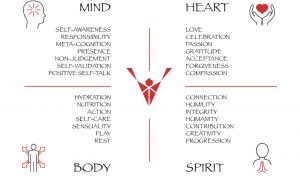
These experiences have enabled me to develop an integrated coaching model to simplify and synthesize my understanding so far. I am sure we will agree, and also disagree. You may consider it a way to trigger powerful inner dialogue and hopefully, empower positive change. 

Mind 

Self-awareness. Responsibility. Meta-cognition. Presence. Non-judgement. Self-validation. Positive Self-talk. 

Know yourself. Find your purpose. Live your path. Be authentic. Take personal responsibility for the things in your life that you can control. Stop playing the victim. Step up and if you don’t like something – change it! Steer and guide your mind towards your desired states and re-frame negative and/or toxic thoughts. Tame your gremlin. Laugh at your monkey mind. Breathe. Be present. Get yourself out of crisis mode. Learn to do nothing (consciously). The past is gone and the future is never here. Be understanding of others, you don’t know their stories. See-through your subjective narratives. Be patient with yourself. Have an internal sense of validation and always do your best. Realize that you can only control your actions, emotions, and thoughts. Be the rock, not the leaf. Consciously practice positive self-talk. Be aware of your own stories. Become aware that you are not your thoughts. Design your intentions. Commit to your actions.  

 Heart 

Love. Celebration. Passion. Gratitude. Acceptance. Forgiveness. Compassion 

Love yourself. Love others. Love your life. Be open to receiving love. Be generous to give love. Laugh! Do the things that give you joy! Reconnect with your inner child. Be curious and be infused with a sense of wonder. Create beautiful moments for others. Live with courage and fire! Do the things that motivate you and compel you to be great. Fuel your confidence by being super brave. Take action despite of fear. Maintain a constant feeling of gratitude. Diffuse negative emotions with positive affirmations and (opposing) actions. Accept impermanence, randomness, death, change, duality, and the things that you cannot control. Accept yourself but move towards change. Learn to accept that ‘paradox’. Forgive others. Forgive yourself. Forgive everyone for what they have ‘done’. Emotional suffering is self-inflicted. Rid your heart of comparison to others, criticism, jealousy complaining, and envy. See our similarities. Find your inner peace. 

Body 

Hydration. Nutrition. Action. Self-care. Sensuality. Play. Rest 

Drink water. Yes everyone knows this but do you drink 2 liters of pure water every day? Eat real food. Eat balanced meals. Eat natural. Avoid processed, chemical, and mutated junk.  

But – allow yourself to indulge every once in a while. Take radical action towards your goals! Get active. Exercise and mix it up. Sweat! Push yourself physically and get strong. Find and feed your ‘flow’ states. Take very good care of yourself (health, style, grooming, hygiene, etc.) Be generous and loving with yourself. Experience pleasure, peak states, joy, adrenaline, etc. Become aware of your 5 senses. Get a massage, cook a meal, make love slowly, smell the flowers, go for a swim in the ocean. Play, dance, jump, run, skip, spin and tumble. Fall and then get up and do it all over again. Sleep 7-8 hours every 24 hours. Get rid of the things that affect your sleep quality (TV, social media, ambient light, etc.) In the words of Covey: “Sharpen the saw!” 

Spirit 

Connection. Humility. Integrity. Humanity. Contribution. Creativity. Progression 

Connect with yourself. Connect with god. Connect with people. Connect with nature. Accept your place in the natural order of things. You can be great and still be humble. Treat everyone as a teacher. Accept that you can learn from everyone. Be honest. Tell the truth to yourself and others. There is no reason to lie. Be kind and gentle with others. Realize that we all share the same human condition. Relieve the suffering of others. Smile. Be kind. Be generous. Contribute and be part of something bigger than yourself (charity, education, family, altruism, community, etc.) Channel your creative energy through writing, dancing, music, drawing, sculpture, painting, etc. Experience art. Be comfortable with catharsis. Continue to progress on your spiritual journey but remain grounded in the things that make us human. Find balance. Be your best.