


I AM TAXONOMY BUSINESS PAGE
YES I AM A DLC_COMMITTEE TAX PAGE
Committee: Governance
The Governance committee in the ESG domain aims to use the strength of this unique global platform that uniting global experts from different jurisdictions, to share and learn from best practices in the area of ethical governance, compliance with applicable laws, legislation and policies as they relate to the way in which a company defines its purpose and abides by codes of ethical conduct and practice in the attainment of its goals and mission. Filtered and carefully curated knowledge will help members to make effective decisions, comply with the law, and meet the needs of their internal and external stakeholders.
“Carbon Footprint Reduction and Climate Action for Entrepreneurs” .
“We were honored to have Mr. Vishal S. Budhia grace our “”Generating Value through ESG Compliance”” workshop! His visionary insights on “”Carbon Footprint Reduction and Climate Action for Entrepreneurs”” left us inspired and empowered to make a difference!
Vishal Budhia is an esteemed member of the Surat Chapter and the Founder and Managing Director of Steamhouse India Limited. He introduced the pioneering concept of supplying steam through a distributed overhead pipeline network in the country, making significant strides toward sustainability.
Together, we embraced the future of sustainable entrepreneurship and uncovered innovative strategies to embed ESG principles into business models. Mr.Vishal S. Budhia’s impactful session shed light on how ESG compliance can elevate brand reputation, attract impact investors, and drive positive change for a better world.
Connect with trailblazers, innovators, and leaders from across the globe. As a DLC member, unlock exclusive benefits, gain access to incredible events, and seize priceless networking opportunities.”
“Addressing Climate Change Risks and Opportunities in the Chemical Industry”.
“We were honored to have Mr. Siddharth Pradhan grace our “”Generating Value through ESG Compliance”” workshop! His visionary insights on “”Addressing Climate Change and Opportunities in the Chemical Industry”” left us inspired and empowered to make a difference!
Mr. Siddharth Pradhan, Honorary Secretary of the Biodiesel Association of India, captivated the audience with his wealth of expertise from previous experiences at HDFC Bank Ltd. and a Miami, Florida-based Hedge Fund. Mr. Pradhan’s impactful session shed light on how ESG compliance can elevate brand reputation, attract impact investors, and drive positive change for a better world.
Connect with trailblazers, innovators, and leaders from across the globe. As a DLC member, unlock exclusive benefits, gain access to incredible events, and seize priceless networking opportunities.”
Generating Value Through ESG Compliance Workshop
Good Governance
What is holding Women back from making Sustainable Financial Investments?
The Science of Success: Understanding Business Strategies
Mr. Rajinder Bhatia discusses his area of expertise, business unit plans, as well as several government policies that are critical in the policy-making process. Hear him discuss how to improve your leadership abilities.
How to make your organization Governance ready
Driving circular economy through partnerships and collaboration
The circular economy is an economic model in which we keep resources in use for as long as possible, extract the maximum value from them while in use and then recover and regenerate materials at the end of each service life. The transition towards a circular economy offers a platform for multi-level stakeholder collaboration to deal with the challenges of resource constrain and waste generation. Accenture’s book on “Waste to Wealth” indicates that shifting towards a circular economy could release about $4.5 trillion in new economic potential by 2030. Increasingly, corporations are turning towards collaborative partnerships to develop and implement circular economy strategies.
The Circular Economy Model
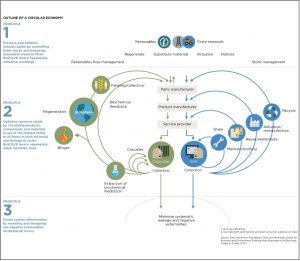
The shift to a circular economy has seen companies seize untapped opportunities to develop innovative business models. Here are some examples of how companies have collaborated to drive circular economy in various sectors.
Aramark: Reducing food waste
Foodservice provider Aramark, headquartered in the United States and with operations in 19 countries, partners with food waste reduction experts LeanPath to improve food waste prevention and minimization. By integrating LeanPath’s food tracking and analytics technology platform across 500 of its largest accounts, Aramark is able to accurately track food production by monitoring orders received and preparing required quantities of servings. Having rolled out LeanPath’s technology platform across 161 of its operating sites since 2016, Aramark has reduced food waste by about 44% and amount of food sent to landfills by 479 tonnes. In cases of food overproduction, unserved food is donated to local relief agencies or sent for composting. These implementations will assist Aramark in meeting its food waste reduction target of 50% by 2030 from its 2015 baseline.
H&M: Regenerating value in clothes
In early 2013, H&M launched a global in-store clothing collection program to encourage customers to return their used clothes in exchange for vouchers. To manage the downstream processing of the collected clothes, H&M partnered with reverse logistics service provider I:CO. I:CO assists in the manual sorting of collected clothes for re-wear, reuse, recycling or energy generation. It is estimated that about 40-60% of the clothes collected by H&M are suitable for re-wear and made available for second-hand sales worldwide. I:CO’s main revenue stream is generated from these sales, especially the high-value vintage garments.
At the next level, about 5-10% of collected clothes are reused as cleaning clothes or cascaded into other products as they are not suitable for re-wear. About 30-40% of collected clothes cannot be reused. They are either recycled to textile fibres or used to manufacture products such as damping and insulating materials in the automotive industry. The rest of the clothes are burnt to produce energy for thermal utilization.
H&M also partners with a supplier in Pakistan to recover fibres from jeans. Collected end-of-use jeans are shipped to partner facilities. They are then crushed and respun into fibres to be used as input for the manufacture of new jeans. The respun fibres replace about 20 to 25% of virgin materials needed for manufacturing a new pair of new jeans. H&M’s long-term aim is to find solutions for reusing and recycling all textile fibres for new uses and to use yarns made from collected textiles in their products. To meet its vision, surplus funds from the clothing collection program are donated to the H&M Conscious Foundation which supports research and innovation in reverse logistics capabilities and closed loop textile production.
DSM-Niaga: Innovative flooring solutions
Established in 2014, DSM-Niaga is a joint venture between DSM, the global life and material sciences company and Niaga, a Dutch based provider of sustainable carpet solutions. The collaboration resulted in the development of Niaga® technology, used to produce the world’s first and only fully recyclable carpet.
The technology is based on a simple set of processes that does not use latex as an adhesive in the manufacturing process. The combination of Niaga’s fibre binding technology and DSM’s engineered adhesive resin technology allows the manufacture of mono-material and duo-material carpets that have easy-to-separate layers, enabling the re-creation of raw materials at the end of the product lifecycle.
In the United States, more than 4 billion pounds of carpet are landfilled annually, making it one of the most common products in landfills today. Niaga® provides the carpet industry with the possibility of making carpet waste obsolete and diverting waste from landfills. Besides closing the material loop for carpet production, Niaga® fibre binding technology allows for as much as 95% energy reduction during carpet production as compared to traditional manufacturing processes. Product Life Cycle Assessments (LCA’s) comparing Niaga® technology to conventional solutions show a reduction of environmental impact by 40- 65% throughout the product lifecycle.
Despite being 100% recyclable, Niaga® technology-based carpets do not compromise on product safety and are intrinsically flame retardant without the need for any additives. After carpets are used, customers are encouraged to sell them back to the manufacturers. To ensure continuous collaborative research and innovation, DSM and Niaga have jointly established a technical centre and production facility in the Netherlands. Interestingly, the name “Niaga” when spelt backwards reads “Again” in a true circular fashion.