


I AM TAXONOMY BUSINESS PAGE
YES I AM A DLC_COMMITTEE TAX PAGE
I AM ON BUSINESS LEVEL
I AM ON BUSINESS LEVEL
Committee: Business
Comprehensive Business Knowledge designed to help you with your strategic, tactical and daily business decisions.
Secret of Being Happier: The 10 things which you can plug in your everyday calendar.
I always thought a good job will give me happiness. Then followed by traveling abroad, having a family, and so on and so forth. It did have a fulfilling feeling but the fact was that it lasted only for a short while and there was again a thirst for more. The ups and downs of life were either too exciting or draining and I began my quest to find the answers to contentment that was long-lasting.
I researched, read, and reflected as much as I could on joy and bliss and the realization that came was “Happiness is a habit, it’s the choices we make on a daily basis so that we are pleased to be who we are.”
So happy people don’t HAVE the best of everything, they MAKE the best of everything. Being happy can have a major impact on the way we live our lives. It’s not just a good feeling but has several positive byproducts e.g. better work performance, greater productivity, a stronger immune system, positive relationships, better self-control, and innate ability to cope with the ups and downs of life.
Happiness can mean different things to different people but the habits that I am sharing have worked with CXOs, Entrepreneurs as well as Students.
Dr. Sonja Lyubomirsky, Professor at University of California, Riverside, and author of the bestseller, “The how of Happiness” reveals that circumstances of our life (such as education, wealth, marital status ) affect 10% of our happiness level. Our genetic footprint is 50% and the remaining 40% is determined by our conscious activity such as habits, values, and actions.
Happiness is not something readymade, it comes from your own actions – HH Dalai Lama
Over the last 7 years of my work in the field of happiness and working closely with thousands of people across countries, cultures, gender orientation and generations in workshops and coaching sessions, I distilled 10 habits you can plug into your daily life and increase your happiness quotient:
-
- Develop a growth Mindset: Happiness doesn’t come from achieving a goal; it comes from the act of progressing towards that goal. Growth mindset, a term coined by Carol Dweck, author of Mindset – The Psychology of success says that such people have the ability to realistically assess where they stand, accept their shortcomings and change their behavior for the better. If you think you have a fixed mindset; ask yourself: How can I change it? Another way of working on your mindset is to reflect on areas where things didn’t go well. What did you learn from that experience? The point is to reflect on the learning and take suitable actions.
- Self-love: A state of appreciation and unconditional acceptance for oneself that grows from our actions, high regard for our own needs and not sacrificing our well-being to please others is self-love. We live in an imperfect world with disruptions all around us. Social media adds to the collective sense of self-doubt continuously questioning our self-worth. We may have been told that we are not good enough. With self-compassion we manage to balance the shortcomings with love and optimism so to live a happy life, empower yourself by transforming limiting beliefs to powerful affirmations. “I love myself and I deserve a happy life.”
- Exercise: Movement contributes to greater happiness. There has been a lot of research and data that proves that as little as 7 minutes of exercise can uplift our mood. When we exercise it increases our happy hormones – endorphins, dopamine, and adrenaline. It helps build confidence and that leads to a happier and more empowered life. For people whose minds are not their best friends and deal with worrying, something as simple as an outdoor walk or bike ride can have an immediate meditation-like effect, says health psychologist Dr. Kelly McGonigal.
- Good Mood Food: If your plate is full of colorful fruits and veggies, you already are in a better mood zone. Antioxidants are health – and disease-protective bioactive chemical compounds produced by plants. A large Swiss survey reported significant associations between higher fruit and vegetable consumption and reduced distress levels. People who ate less than the five-servings-a-day recommendation had a higher likelihood of reporting stress and anxiety than those who didn’t. So watch out for your happiness could be on your plate. Always consult your nutritionist if you have specific concerns.
5. Invest in memories: This fast pace, the consumer-oriented world says “Buy your way to happiness!!” From insurance to cars, food to homes everywhere we look we are flooded with this message. A study at San Francisco State University found that people who spent money on experiences rather than material things were happier and felt the money was better spent. The thrill of buying can fade soon but the joy of experience can last for a lifetime!
6. Smart Goals: Big or small goals can be the stepping stone for a happier life. Specific, measurable, actionable, realistic, and time-bound ( SMART) goals help you get what you want in life. Tony Robbins says Progress = Happiness. So grab your pen and paper, reach out for support, hire a coach and design your life just the way you want!
7. Be Generous: It isn’t rocket science that doing nice things for people feels good. Giving activates an area in the brain linked to contentment. When we do something for someone else, we typically give away some of our personal resources, such as time, energy, or money. Some studies have found that people are happier when spending money on others than on themselves, and this happiness motivates them to be generous in the future. And even small acts of kindness, like picking up something someone else has dropped, make people feel happy. Generosity is also associated with benefits in the workplace, such as reducing the likelihood of job burnout, and in relationships, where it is associated with more contentment and longer-lasting romantic relationships.
8. Circle of influence: People need people and research shows that happy people increase your chances of being happy by 15%. A Harvard Medical School study of 5,000 people over 20 years found that one person’s happiness spreads through their social group even up to three degrees of separation and that the effect lasts as long as a year. So keep scheduling those happy hours with friends and create strong social support for yourself.
9. Practice Forgiveness: Forgiveness is a gift you give yourself. It’s a conscious choice we make to release feelings of hate and resentment. It does not mean reconciling with the event or person, it just means that you do not want to dwell on those negative feelings even in your own time and mind-space. Forgiveness benefits you more than it benefits the person you forgive. Would you like to start with forgiving yourself?
10. Expressing Gratitude: Thankfulness is strongly and consistently associated with greater happiness, better relationships, and positive emotions. We can express gratitude in many ways. Applying it to the past (upbringing, experiences, education), present (home, family, career), and future (manifestations). It helps people refocus on what they have instead of what they lack. So pick a time, count your blessings and feel the bliss.
Happiness has a positive footprint in every aspect of our life from income to longevity. Leaving it to external events and other people will only cause frustration. You are in charge of your life and happiness. Grab a pen and become the author of your life. Ready?
Holistic wellbeing: an integrated approach to being your best
What is holistic wellness?
“The broader definition of holistic wellness uses the literal meaning of the word “holistic.” That is, it defines wellness as the interdependence of several dimensions of health. The whole person, therefore, isn’t well unless they’re well in every area of life — not just physical health. While experts debate which areas should be included in holistic wellness, most agree that it encompasses mental, emotional, and physical health.”
In my own experience, this is very true. I have always strived to achieve my fullest potential in all areas and aspects of my life. In school, I was a straight-A student, but I wasn’t very conscious of my nutrition habits or fitness levels. In my early career, I was very creative and driven, working hard to achieve my professional goals, but I often neglected my social network and lost touch with many friends. There have been times in my adult life when I strayed from the path and got caught up in lust, power, and greed. So would say, all of this is necessary for me to become who I am and unlock my full potential.
These experiences have enabled me to develop an integrated coaching model to simplify and synthesize my understanding so far. I am sure we will agree, and also disagree. You may consider it a way to trigger powerful inner dialogue and hopefully, empower positive change.
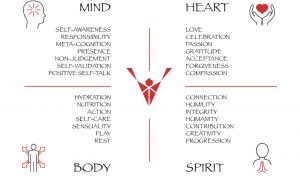
Mind
Self-awareness. Responsibility. Meta-cognition. Presence. Non-judgement. Self-validation. Positive Self-talk.
Know yourself. Find your purpose. Live your path. Be authentic. Take personal responsibility for the things in your life that you can control. Stop playing the victim. Step up and if you don’t like something – change it! Steer and guide your mind towards your desired states and re-frame negative and/or toxic thoughts. Tame your gremlin. Laugh at your monkey mind. Breathe. Be present. Get yourself out of crisis mode. Learn to do nothing (consciously). The past is gone and the future is never here. Be understanding of others, you don’t know their stories. See-through your subjective narratives. Be patient with yourself. Have an internal sense of validation and always do your best. Realize that you can only control your actions, emotions, and thoughts. Be the rock, not the leaf. Consciously practice positive self-talk. Be aware of your own stories. Become aware that you are not your thoughts. Design your intentions. Commit to your actions.
Heart
Love. Celebration. Passion. Gratitude. Acceptance. Forgiveness. Compassion
Love yourself. Love others. Love your life. Be open to receiving love. Be generous to give love. Laugh! Do the things that give you joy! Reconnect with your inner child. Be curious and be infused with a sense of wonder. Create beautiful moments for others. Live with courage and fire! Do the things that motivate you and compel you to be great. Fuel your confidence by being super brave. Take action despite of fear. Maintain a constant feeling of gratitude. Diffuse negative emotions with positive affirmations and (opposing) actions. Accept impermanence, randomness, death, change, duality, and the things that you cannot control. Accept yourself but move towards change. Learn to accept that ‘paradox’. Forgive others. Forgive yourself. Forgive everyone for what they have ‘done’. Emotional suffering is self-inflicted. Rid your heart of comparison to others, criticism, jealousy complaining, and envy. See our similarities. Find your inner peace.
Body
Hydration. Nutrition. Action. Self-care. Sensuality. Play. Rest
Drink water. Yes everyone knows this but do you drink 2 liters of pure water every day? Eat real food. Eat balanced meals. Eat natural. Avoid processed, chemical, and mutated junk.
But – allow yourself to indulge every once in a while. Take radical action towards your goals! Get active. Exercise and mix it up. Sweat! Push yourself physically and get strong. Find and feed your ‘flow’ states. Take very good care of yourself (health, style, grooming, hygiene, etc.) Be generous and loving with yourself. Experience pleasure, peak states, joy, adrenaline, etc. Become aware of your 5 senses. Get a massage, cook a meal, make love slowly, smell the flowers, go for a swim in the ocean. Play, dance, jump, run, skip, spin and tumble. Fall and then get up and do it all over again. Sleep 7-8 hours every 24 hours. Get rid of the things that affect your sleep quality (TV, social media, ambient light, etc.) In the words of Covey: “Sharpen the saw!”
Spirit
Connection. Humility. Integrity. Humanity. Contribution. Creativity. Progression
Connect with yourself. Connect with god. Connect with people. Connect with nature. Accept your place in the natural order of things. You can be great and still be humble. Treat everyone as a teacher. Accept that you can learn from everyone. Be honest. Tell the truth to yourself and others. There is no reason to lie. Be kind and gentle with others. Realize that we all share the same human condition. Relieve the suffering of others. Smile. Be kind. Be generous. Contribute and be part of something bigger than yourself (charity, education, family, altruism, community, etc.) Channel your creative energy through writing, dancing, music, drawing, sculpture, painting, etc. Experience art. Be comfortable with catharsis. Continue to progress on your spiritual journey but remain grounded in the things that make us human. Find balance. Be your best.
Chatbots – A trending tool to enhance customer experience
The customer experience is the pivotal point for every hospitality organization. As much as a good experience can create the best marketing avenue for the organization, a poor experience can lead to severe reputational damage. Staying engaged with guests, responding to their enquiries speedily, and attending to any problems immediately is a simple strategy to ensure the quality of the guest experience.
This is where chatbots can step in. Conversational chatbots can be the perfect assistant for the hospitality staff in delivering personalized and engaging experiences. From simple rule-based chatbots to AI-based chatbots, this technology has developed over the years to become a simple yet powerful solution in the hospitality industry. Unsurprisingly, the global chatbot market has been on the rise for the past few years, with it expected to grow to $9.4 billion in 2024 at an annual compound growth rate of 29.7%, according to Business Insider.
What does a chatbot do?
Chatbots use Natural Language Processing to extract specific information from conversations, be it text-based, speech-to-text, or speech-to-speech conversations. It allows the chatbot to identify the purpose of the message and select the appropriate auto-response or direct the enquiry to a human agent. Once the intent is recognised, chatbots can also search its database and provide answers or relevant resources. For instance, if a guest asks the in-hotel chatbot for directions to the hotel spa, the chatbot can pull up a map and provide interactive directions instantly. On the other hand, if a guest wants to set up a special dinner for their partner’s birthday, the chatbot can forward the request to the relevant staff member.
How does it enhance customer experience?
Instant, 24/7 service
It is hardly a secret, that customers hate to wait, whether in a physical queue or a digital conversation. It is especially challenging for the hospitality sector since customer queries can come from all over the globe from different time zones. Besides, a guest who needs assistance at 3 am is not going to be happy if they have to wait for an operator to pick up their requests.
A hotel chatbot can instantly assist customers with round-the-clock support, eliminating most waiting times. Even when the staff is unavailable, chatbots can continue to support the guests, creating a seamless experience. Moreover, since chatbots can cater to multiple requests at once, customers can get instant services even on the busiest days.
Personalized experiences
AI-based chatbots are programmed to analyse information received throughout a string of conversations with a particular customer to identify their preferences. They can use this information to provide suggestions that are relevant and personalized. This information will also be useful in more personalized upselling and cross-selling. Moreover, these chatbots can generate reports and analytic data that enable the hotel staff to identify customer trends and effectively cater to them.
Another impressive feature of chatbots is that they can be configured to accommodate multiple languages, dialects, emojis, and even typos. Customers are undoubtedly going to be delighted to be interacting with digital services that can cater to them in their comfort zone instead of making them second-guess their language skills.
Support throughout the guest journey
Chatbots can create a consistent and seamless guest journey from pre-booking to post-stay. This technology can detect customers who linger in the booking process and offer assistance as required. Chatbots can also guide the guest through their stay, suggesting activities and services based on the guest profile. Once the guest is ready to checkout, a chatbot can pick up guest feedback, taking in both positive and negative comments, making the guest’s opinions feel heard and acknowledged. Even after the guest has left the establishment, chatbots can reach them on various channels and let them know about any hotel updates and ongoing promotions.
Moreover, with AI-based chatbots, there won’t be any missed customer queries or missed tasks. These chatbots can be set up with notification and reminder systems to notify the staff about any job pending with a particular customer.
In the era of social distancing and personalized services, chatbots can drive conversations and enable meaningful engagement with customers. The relevant and attentive service chatbots provide comes a long way in creating seamless and memorable experiences for customers.
How to prepare for a Strategy planning session
73 Questions with Alok Aggarwal
73 Questions with Rohan Malhotra
73 Questions with Daniel Bernard
The 5 Stages to build Unshakeable Trading Self Mastery
Stage One: Unconscious Incompetence
This is the first step you take when starting to look into trading. You know that it is a good way of making money because you’ve heard so many things about it and heard of so many millionaires. Unfortunately, just like when you first desire to drive a car you think it will be easy – after all, how hard can it be? Price either moves up or down – what’s the big secret to that then – let’s get cracking!
Unfortunately, just as when you first take your place in front of a steering wheel you find very quickly that you haven’t got the first damn clue about what you’re trying to do.
You take lots of trades and lots of risks. When you enter a trade, it turns against you, so you reverse and it turns again, and again, and again. You may have initial success and that’s even worse because it tells your brain that this really is simple and you start to risk more money. You try to turn around your losses by doubling up every time you trade. Sometimes you’ll get away with it but more often than not you will come away scratched and bruised (and significantly poorer!). You are totally oblivious to your incompetence at trading.
Stage Two – Conscious Incompetence
Stage two is where you realize that there is more work involved in trading and that you might actually have to figure a few things out. You consciously realize that you are an incompetent trader – you don’t have the skills or the insight to turn a regular profit. You now set about investigating then buying trading systems and e-books galore, you read websites based everywhere from USA to Australia to Ukraine and begin your search for the holy grail. During this time you will be a system nomad – you will flick from method to method day by day and week by week never sticking with one long enough to actually see if it does work. Every time you come upon a new tool or indicator you’ll be ecstatic that this is the one that will make all the difference.
You will test out automated systems, you’ll play with moving averages, Fibonacci lines, support & resistance, pivots, waves, fractals, divergences, DMI, ADX, and a hundred other things all in the vain
hope that your ‘magic system’ starts today. You will also become a top and bottom picker, trying to find the exact point of reversal with your indicators and you’ll find yourself chasing losing trades and even adding to them because you are so sure you are right. You’ll go into live chat rooms and see other traders making profits and you want to know why it’s not you. You’ll ask a million questions, some of which are so dumb that looking back you feel a bit silly.
You’ll then reach the point where you think all the ones who say they are making profits are all liars – they can’t be making that amount because you’ve studied and you don’t make that, you know as much as they do and they must be lying. But they’re in there day after day and their account just grows while yours falls. You will be like a teenager – the traders that make money will freely give you advice but you’re stubborn and think that you know best. You take no notice and overtrade your account even though everyone says you are crazy to, but you know better. You’ll consider following the calls that others make but even then it won’t work so you try paying for trading signals from someone else – they don’t work for you either.
You might even approach a guru or someone on a chat board who promises to make you into a trader (usually for a fee of course). Whether the guru is good or not you won’t win because there is no replacement for screen time and you still think you know best. This stage can last ages and ages – in fact in reality talking with other traders as well as personal experience confirms that it can easily last well over a year and more nearer to three years. This is also the stage when you are most likely to give up through sheer frustration. Around 60% of new traders quit in the first 3 months – they give up and this is good – think about it – if trading was easy we would all be millionaires.(and the opportunity would’nt exist). For a small number of traders to be consistently prroftiable a large number of traders need to lose money regularly. Your goal is to be amongst the small % that are profitable.
Another 20% keep going for a year and then in desperation take risks guaranteed to blow their account which of course it does. What may surprise you is that of the remaining 20% most of them will last around 3 years and they will think they are safe in the water but even at 3 years only a further 5-10% will continue and go on to actually make money consistently. By the way – these are real figures, not just some I’ve picked out of my head – so when you get to 3 years in the game don’t think it is plain sailing from there! I’ve had many people debate with me about these timeframes – funnily enough none of them have been trading for more than 3 years – if you think you know better
– then look on a chat board for someone who’s been trading for 5 years and ask them how long it takes to become fully 100% proficient.
Sure I guess there will be exceptions to the rule – but I haven’t met many yet. Eventually you do begin to come out of this phase. You’ve probably committed more time and money than you ever thought you would, lost 2 or 3 loaded accounts and all but given up maybe 3 or 4 times but now it is in your blood. One day – in a split second moment you will enter stage 3.
Stage Three – The Eureka Moment
Towards the end of stage two you begin to realize that it’s not the system that is making the difference. You realize that it is actually possible to make money with a simple swing trading system and nothing else IF you can get your head and money management right. You start to read books on the psychology of trading and identify with the characters portrayed in those books and finally comes your eureka moment. This eureka moment causes a new connection to be made in your brain. You suddenly realize that neither you, nor anyone else can accurately predict what the market will do in the next ten seconds, never mind the next 20 minutes.
Because of this revelation you stop taking any notice of what anyone thinks – what this news item will do, and what that event will do to the markets. You become an individual with your own method of trading. You start to work just one system that you mold to your own way of trading, you’re starting to get happy and you also get much better at defining your risk threshold. You start to take every trade that your ‘edge’ shows has a good probability of winning (landing on the right side of probability). When the trade turns bad you don’t get angry or try to get even because you know in your head that as you couldn’t possibly predict it, it isn’t your fault – as soon as you realize that the trade is bad you close it. You take the loss as a learning opportunity. The next trade or the one after it or the one after that will have higher odds of success because you know your system works. You stop looking at trading results from a trade-to-trade perspective and start to look at weekly figures knowing that one bad trade does not ‘a poor system make’.
You have realized in an instant that the trading game is about one thing – consistency of your ‘edge’ coupled with the mind you bring to the moment of performance. Your develop discipline to take all the trades your system triggers no matter, what as you know the probabilities stack in your favor. You learn about proper money management and leverage – risk of account etc. – and this time it
actually soaks in and you think back to those who advised the same thing a year ago with a wry smile. You weren’t ready then but you are now. The eureka moment came the moment that you truly accepted that you cannot predict the market, but you can control the mind you bring.
Stage Four – Conscious Competence
You are making trades whenever your system tells you to. You take losses just as easily as you take wins. You now let your winners run to their conclusion fully accepting the risk and knowing that your system makes more money than it loses. When you see the trade is a loser you close it swiftly with little pain to your account. You are now at a point where at a minimum you break even – day in day out. You will have weeks where you make big money and other weeks where you lose big money – but overall you are breaking even and not losing money anymore. You are now conscious of the fact that you are making calls that are generally good and you are getting respect from other traders as you chat the day away. You still have to work at it and think about your trades but as this continues you begin to make more money than you lose consistently. You’ll start the day on a good win,then take a loss and have no feelings that you’ve given those profits back because you know that it will come back again. You know instinctively that the market ALWAYS gives more trading opportunities.You will slowly begin to make consistent profits week in and week out.
Stage Five – Unconscious Competence
Now we’re cooking – just like driving a car, every day you get in your seat, buckle up and trade. You do everything now on an unconscious level. You are running on autopilot. You start to pick the really big trades and getting big profits in a day doesn’t make you any more excited than getting none. You see the newbies in the forum shouting ‘go market go’ as if they are urging on a horse to win in the grand national and you see yourself – but many years ago now. This is trading utopia – you have mastered your emotions and you are now a trader with a rapidly growing account. You’re a star in the trading chat room and people listen to what you say. You recognize yourself in their questions from two or three years ago. You pass on your advice just as others did to you, but you know most of it is futile because they’re teenagers – some of them will get to where you are – some will do it fast and others will be slower – literally hundreds and thousands will never get past stage two, but a few will.
Trading is no longer exciting – in fact it’s probably boring you to pieces – like everything in life when you get good at it or do it for your job – it gets boring – you’re doing your job and that’s that. Finally you grow out of the chat rooms and find a few choice people who you converse with about the markets without being influenced at all. All the time you are honing your methods to extract the maximum profit from the market without increasing risk. Your method of trading doesn’t change – it just gets better – you now have what some people call ‘intuition.’ You can now say with your head held high “I’m a trader” but to be honest you don’t even bother telling anyone – it’s a job like any other.
I hope you’ve enjoyed reading this journey into a traders mind and that hopefully you’ve identified some points here that resonate with you. Remember that whilst less than 5% will actually make it – the reason for that isn’t ability or intellect or knowledge, its staying power and the ability to change your perceptions and paradigms as new information comes available. The losers are those who wanted to ‘get rich quick’ and approached the market with this blinkered thinking, blinding them to seeing the obvious – a kind of “this is the way I see it and that’s that” scenario – refusing to assimilate new information that changes that perception.
I’m more than happy to confess to you that the reason I started trading was because of the ‘get rich quick’ mindset. Now I see it correctly as a ‘get rich slow’ profession.
If you’re thinking about giving up I have one piece of advice for you:
Ask yourself the question “How many years would you go to University if you knew for a fact that there was a million dollars a year job at the end of it?”