
I AM TAXONOMY PAGE

The Great Resignation as the Great Career Revival

The idea of the Great Resignation originated in the United States and was proposed by Texas A&M Professor, Anthony Klotz.  It proposed the observation of a phenomenon that is happening now with record numbers of people leaving their jobs as the COVID19 pandemic continues to unfold. Rough estimates suggest that 33 million Americans have quit their jobs since the spring of 2021.

Specific observations on the Great Resignation included the following:

  • The resignation seems to occur most among mid-career workers

There is greater demand for mid-level workers due to their experience. This gives mid-career types greater leverage in securing employment opportunities.

  • The highest rate of resignation is happening in technology and healthcare

Resignation rates among workers in these sectors are attributed to high demands and the experience of significant stress which have resulted in increased workloads and burnout.

  • People are placing a priority on their health and well-being

Many workers have reached a breaking point after months of high workloads, hiring freezes, work pressures and the absence of proper work boundaries and respect for personal time. These factors have caused many to rethink their work and life goals. Many are opting for greater focus on their health and well-being.

What has it taught us?

What the pandemic has certainly taught us is that things are not expected to return to normal as people and organizations have been forced to rethink the very notion of work. It heralded Future of Work conversations in an unprecedented way. Hybrid, remote and working-from-home have all become permanent features of the New Normal. In fact, the phenomenon is still playing out as experts have yet to see the full extent of what a post pandemic workplace will look like. One thing is for sure – organizations will need to move away from any one-size-fits-all approach to managing the challenges of onboarding, developing and retaining talent in a post pandemic world in a far more novel way.

A clear outcome is that people have many choices now. Employees who are self-motivated and willing to assume greater agility and control over their careers have discovered that it was possible to do so at a much greater rate of participation than ever before. They look for opportunities which allow for that agility to be expressed in the way they desire, and more importantly, at their time and pace.

Conversely, the pandemic has also caused a significant mental toll. In a study by the American Psychological Association, “Stress in America”, it found that 32% of adults were stressed by the pandemic and even to the point of dealing with daily routine decisions such as what to eat or wear.

What has it taught organizations?

The idea of centralized leadership is being challenged by a more fundamental shift towards self-leadership. In the war for talent, successful organizations have turned their focus on people in a big way. More than ever, they understand that the emphasis has to be on empowering workers, making permanent flexible work arrangements permanent, putting in place health and well-being programs, having blended workforce solutions, investments in technology and artificial intelligence, and last but not least, building a culture of trust. In essence, the key is “having work fit around personal lives and not personal lives around work” (Anthony Klotz).

It is actually an opportunity to herald the Great Revival

In my survey of the vast literature out there on the topic, I have arrived at the following 4 Eureka moments:

  • The Great Resignation is not mainly about compensation anymore. Virtual and remote work is here to stay and people are exercising greater control and flexibility over their lives.
  • The strongest predictor of staff turnover is a toxic culture. Failure to demonstrate respect, promote diversity and inclusion, focus on equity and unethical behavior will further drive up the Great Resignation.
  • Failure to recognize performance and value will drive your better performers to quit and seek greener pastures.
  • Response to the pandemic and having a clear vision of the future which motivates and inspires. Leadership plays a critical role in setting the right tone in visibly demonstrating competence during a crisis, and at the same time, raising the bar when it comes to looking after their most prized assets – their human capital.
Driving circular economy through partnerships and collaboration

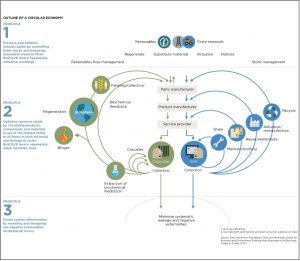
The circular economy is an economic model in which we keep resources in use for as long as possible, extract the maximum value from them while in use and then recover and regenerate materials at the end of each service life. The transition towards a circular economy offers a platform for multi-level stakeholder collaboration to deal with the challenges of resource constrain and waste generation. Accenture’s book on “Waste to Wealth” indicates that shifting towards a circular economy could release about $4.5 trillion in new economic potential by 2030. Increasingly, corporations are turning towards collaborative partnerships to develop and implement circular economy strategies.

The Circular Economy Model

The shift to a circular economy has seen companies seize untapped opportunities to develop innovative business models. Here are some examples of how companies have collaborated to drive circular economy in various sectors.

Aramark: Reducing food waste

Foodservice provider Aramark, headquartered in the United States and with operations in 19 countries, partners with food waste reduction experts LeanPath to improve food waste prevention and minimization. By integrating LeanPath’s food tracking and analytics technology platform across 500 of its largest accounts, Aramark is able to accurately track food production by monitoring orders received and preparing required quantities of servings. Having rolled out LeanPath’s technology platform across 161 of its operating sites since 2016, Aramark has reduced food waste by about 44% and amount of food sent to landfills by 479 tonnes. In cases of food overproduction, unserved food is donated to local relief agencies or sent for composting. These implementations will assist Aramark in meeting its food waste reduction target of 50% by 2030 from its 2015 baseline.

H&M: Regenerating value in clothes

In early 2013, H&M launched a global in-store clothing collection program to encourage customers to return their used clothes in exchange for vouchers. To manage the downstream processing of the collected clothes, H&M partnered with reverse logistics service provider I:CO. I:CO assists in the manual sorting of collected clothes for re-wear, reuse, recycling or energy generation. It is estimated that about 40-60% of the clothes collected by H&M are suitable for re-wear and made available for second-hand sales worldwide. I:CO’s main revenue stream is generated from these sales, especially the high-value vintage garments.

At the next level, about 5-10% of collected clothes are reused as cleaning clothes or cascaded into other products as they are not suitable for re-wear. About 30-40% of collected clothes cannot be reused. They are either recycled to textile fibres or used to manufacture products such as damping and insulating materials in the automotive industry. The rest of the clothes are burnt to produce energy for thermal utilization.

H&M also partners with a supplier in Pakistan to recover fibres from jeans. Collected end-of-use jeans are shipped to partner facilities. They are then crushed and respun into fibres to be used as input for the manufacture of new jeans. The respun fibres replace about 20 to 25% of virgin materials needed for manufacturing a new pair of new jeans. H&M’s long-term aim is to find solutions for reusing and recycling all textile fibres for new uses and to use yarns made from collected textiles in their products. To meet its vision, surplus funds from the clothing collection program are donated to the H&M Conscious Foundation which supports research and innovation in reverse logistics capabilities and closed loop textile production.

DSM-Niaga: Innovative flooring solutions


Established in 2014, DSM-Niaga is a joint venture between DSM, the global life and material sciences company and Niaga, a Dutch based provider of sustainable carpet solutions. The collaboration resulted in the development of Niaga® technology, used to produce the world’s first and only fully recyclable carpet.


The technology is based on a simple set of processes that does not use latex as an adhesive in the manufacturing process. The combination of Niaga’s fibre binding technology and DSM’s engineered adhesive resin technology allows the manufacture of mono-material and duo-material carpets that have easy-to-separate layers, enabling the re-creation of raw materials at the end of the product lifecycle.


In the United States, more than 4 billion pounds of carpet are landfilled annually, making it one of the most common products in landfills today. Niaga® provides the carpet industry with the possibility of making carpet waste obsolete and diverting waste from landfills. Besides closing the material loop for carpet production, Niaga® fibre binding technology allows for as much as 95% energy reduction during carpet production as compared to traditional manufacturing processes. Product Life Cycle Assessments (LCA’s) comparing Niaga® technology to conventional solutions show a reduction of environmental impact by 40- 65% throughout the product lifecycle.

Despite being 100% recyclable, Niaga® technology-based carpets do not compromise on product safety and are intrinsically flame retardant without the need for any additives. After carpets are used, customers are encouraged to sell them back to the manufacturers. To ensure continuous collaborative research and innovation, DSM and Niaga have jointly established a technical centre and production facility in the Netherlands. Interestingly, the name “Niaga” when spelt backwards reads “Again” in a true circular fashion.