I AM TAXONOMY PAGE

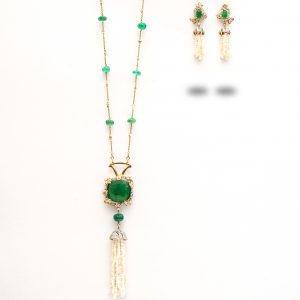
MINIMALIST ACCESSORIES THAT’LL TURN YOU INTO A JEWELLERY PERSON

Minimalists are actual extravagant …. As they wear their mind!!!

Often Minimalists are considered to be one with less, and Maximalists are considered abundant. I am like a bridge between the two so I can give you my perspective of both the lifestyles when it comes to jewelry and what the awakened Gen Z is thinking.

Search the most expensive jewelry in the world, the number 1 listing is The Pink Star, $71.2 million pink star diamond SOTHEBY’S, Sotheby’s Hong Kong, April 2017. Oh, I was thinking it should have been a 100 kg gold set with 50 carat plus white diamond solitaires on it. So that’s where the thinking differs for Minimalists over Maximalists. Though I went too far to give a purview, not all minimalists are billionaires but they think rich, less is more, quality over quantity, and thus shows traits of alpha.  I have a different perspective on sustainability when it comes to jewelry I am a firm believer in all things natural, and ethically sourced to the possibilities. Wear small but wear real is my ideology.

Minimalist jewelry is all the rage for those looking to add subtle pieces to their jewelry collection. By wearing minimalist jewelry, you can add a classic touch of style to your overall look that is sophisticated and elegant; yet cliché. It’s more like wearing your mind … Versatility, as is the notion that the jewelry we wear should be an extension of who we are.

Keeping it simple, basic, and minimal – who would have thought this could be a whole another jewelry trend? Well, but the good part is, it has! And, how wonderfully it has fit into the lifestyle of today’s on-the-go women. After turning a blind eye towards this eternal trend through the experimental and evolving years we have finally realized that the minimal jewelry trend is the one that should have never been away from our sights. Modularity, Werability, and little mechanics takes it to next level.

Just a few years ago it made a visible comeback and in no time it transited from appearing sporadically to becoming a MUST-HAVE! Now that it is here to stay.

Whether delicate and understated or bold and geometric, minimalist fine jewelry has never been more in tune with the times.

Minimalism has come to be associated with ease and effortlessness, a more casual, clutter-free lifestyle, all aspired to in this pandemic era. Minimalist jewelry can be those dainty pendant sets, brooches, hairpins, trinkets, bracelets, stack rings, studs, earrings, anklets, nose pins, piercings, nail rings, etc., in this segment also there are mass-produced pieces, office wears, little statement-making and the “extravaganza “


What is NFTs and will NFTs (non-fungible tokens) in Video Games benefit the Gaming Industry

The worldwide gaming industry creates income across three market subsets: portable, PC, and control center gaming, which together are esteemed in the many billions of dollars and development. Nonetheless, while industry occupants benefit from this strong development, players create a minimal enduring incentive for themselves. Subsequent to putting resources into the costly control centers, computers, or cell phones, players enter gaming conditions that offer a layered admittance client experience. In these conventional games, cash streams in a single heading: Players should burn through cash to access in-game substance and selective highlights.Conversely, blockchain-empowered games – a large number of which are decentralized applications (dApps) – center all the more intensely around producing an incentive for players. This dynamic presents a change in perspective that permits players to more readily catch the utility and worth of resources gained through in-game buys, standard ongoing interaction, or special occasions. For example, when a player buys a defensive layer update in a customary game, their main advantage is improved interactivity inside the setting of that one game. Notwithstanding, in a gaming environment that uses cross-stage non-fungible tokens (NFTs), a similar coverage can be tokenized in a manner that changes in-game buys into adaptable resources that might present advantages across interconnected games or be traded for cash or other computerized resources.Fundamental blockchain networks empower the age and arrangement of these NFTs inside various gaming conditions. Since NFTs are one of a kind and can be intended to hold esteem past the game in which they started, blockchain-constructed games can possibly grow gaming economies emphatically, layout new gaming classes, and fuel the improvement of new games. To investigate how this cycle could unfurl, getting NFTs’ significance first.Non-Fungible Tokens 101Non-fungible tokens aren’t selective to the blockchain gaming industry. These tokens can address computerized and genuine resources like craftsmanship, land, collectibles, and, surprisingly, individual personality. Subsequently, NFTs have a wide scope of functional applications that enticement for different ventures and use cases, and their reception is speeding up. Rather than most other computerized tokens, NFTs show three particular attributes:Non-fungibility:As the name suggests, each NFT is a cryptographic symbolic that addresses something special or non-fungible, meaning it’s not tradable with another NFT. The metadata inside each NFT exists as a long-lasting, unalterable record on the blockchain. This record depicts what the token addresses, like a declaration of realness, as well as the symbolic’s possession history and exchange record (title). Conversely, numerous digital currencies, for example, bitcoin (BTC), ether (ETH), and other utility tokens are fungible – i.e., one BTC is actually indistinguishable from some other – and consequently are not extraordinary in this sense. Extraordinariness:The shortage of each NFT is a significant part of what makes them alluring. For example, in the CryptoKitties game, clients gather and breed computerized felines that are each epitomized by an assigned NFT. A portion of these CryptoKitties is viewed as uncommon collectibles, which thusly expands their asking cost among gatherers who esteem their provable shortage. In 2018, a CryptoKitty named Mythical serpent sold for 600 ETH, which was what might be compared to $170K at that point.Unbreakable quality:Digital forms of money like bitcoin are distinct into more modest units, given their fungibility and planned use as a mechanism of trade. Interestingly, most NFTs should be purchased, sold, and held in a general unit and are in this manner unbreakable – similarly that you can’t buy 10% of a show pass or 60% of a boarding pass.Now that we’ve talked about the characterizing attributes of NFTs, we can start to investigate the benefits of conveying these tokens with regard to web-based gaming.
The Advantages of Gaming NFTsAlbeit numerous NFTs utilize Ethereum’s ERC-721 symbolic norm, NFTs are additionally common in a few different organizations, like TRON (Blockchain Sweeties), EOSIO (EOS Knights), and NEO (Blocklords). The many advantages of decentralized ongoing interaction include:Possession:Customary in-game buys are one-time, non-transferrable ventures that remain secured in a solitary gaming world. Interestingly, involving NFTs in gaming conditions awards players responsibility for in-game resources rather than game designers. Through blockchain innovation, gamers can save in-game buys, offer them to different players, or move them into other upheld games.Provable Shortage:Gatherers esteem extraordinariness and credibility, and the shortage of in-game NFT buys is provable through the unchanging records inserted in a NFT’s fundamental blockchain network. This dispersed public record approves the number and uniqueness of each NFT as well as its proprietorship history.Interoperability:Conventional web-based games exist on unified servers. Thusly, in-game resources exist inside exclusive frameworks that don’t speak with others. Conversely, decentralized games exist on free blockchains that go about as the backend structure for other interconnected games. Therefore, game resources addressed by NFTs can be intended to be interoperable across various conditions. For example, two games based on the Ethereum organization can possibly uphold something similar to in-game resources like vehicles, shields, or even whole characters.Permanence:When a customary internet game closes down, clients customarily lose all of their in-game buys. NFTs, notwithstanding, exist freely on a particular gaming stage and live on the blockchain itself. In that capacity, in-game buys can be traded paying little heed to what befalls the game, and new games can be intended to plug into a current blockchain convention. Moreover, blockchain-empowered game resources can’t be copied or messed with in light of the super-durable record each NFT produces upon issuance.NFTs and the Fate of the Blockchain Gaming IndustryAlbeit the reception of NFTs in the gaming scene accompanies benefits, it likewise presents critical hindrances to survival. Most quite, NFTs should be made really engaging and instinctive to standard purchasers who probably won’t be in fact arranged. Furthermore, on the grounds that NFTs have inherent worth, there’s a gamble that some will be utilized overwhelmingly as speculative resources. This probability could propel players to buy in-game resources with the desire for selling them for future benefit as opposed to involving the resources inside the gaming environment as planned.In spite of these difficulties, the potential for benefit inside the gaming business will rouse more non-blockchain-centered brands to explore different avenues regarding NFTs, probable by shaping associations with outsider blockchain projects that have the specialized ability expected to rejuvenate their vision. All the while, the more extensive outcome of gaming dApps will probably assume a part in further catalyzing NFT foundation upgrades and driving the advancement of imaginative solutions that unlock mainstream adoption.

Guide to your digital marketing strategy in the post-pandemic era

We have seen an unprecedented acceleration and adoption of digital across businesses and the daily lives of people.

Consumers are spending more time on digital, eCommerce, OTT, Gaming, and eSports than ever before.

While businesses are reorienting themselves to the new normal – marketing functions within organizations will need to refresh and reinvent quickly to help put the businesses back on the growth track.

An obvious direction is to dial up your presence on digital. Skew efforts in favor of digital channels.  While this may seem like the promising way ahead – if not done right, this can also be a drain on resources with very little or no change in results.

The sheer number of players flocking for discovery and visibility on digital platforms has made it mandatory to pause and assess.

The need for an integrated and singular brand narrative on digital:

The digital media landscape is complex. Ever-increasing and dynamic platforms, content formats, advertising assets coupled with the need to consistently create content to be in touch with the consumers have left brands looking confused, with no linearity in communication and single thought holding them together.

The increased decibels online-only compound this problem further.

Therefore, building a digital brand identity document is not an option anymore. While the document should honour the fundamentals of brand identity, it should build in definitions, checkpoints, and guardrails for all platforms and content formats on digital. And remember that this document by the very nature of digital will be ever-evolving, and thus agile.

The need for personalization

Cookies are likely to be history soon. While advertisers have a reason to be upset, I also believe there is an interesting and perhaps a more powerful alternative—which is opt-in personalization.

Consumers are now more likely to opt-in for richer and relevant experiences. And as brands, we need to be prepared to give them the best and the most memorable experiences.

This is the job of data and technology.

Priority one is to structure your customer data in meaningful ways. And next – use creativity and technology to make it worthwhile for your consumers that you have their data.

The data that consumers are willing to leave behind for you will be your biggest asset and also your biggest responsibility.

Some ways in which we have done this at DViO are by personalizing branded videos with consumer data at scale, intercepting high potential brand conversations on social and leveraging the opportunity to amplify the brand narrative.

Notable among our personalization initiatives is how we used technology to make every fan of Game of Thrones appear on the key art poster of Game of Thrones.

These are the kind of experiences consumers will remember forever.

The need for conversations

An integral part of personalization is conversations. And brands now have both public platforms (social media) and private platforms (messengers) for conversations with consumers.

Personalized conversations add value, build affinity, and have the potential to build powerful brands.

And thus, the adoption of rule-based conversations or machine learning-based conversations on chatbots enabled across websites, apps and commonly used messenger platforms like Whatsapp, Facebook Messenger, Telegram, etc. will need to become the norm.

Another high potential enabler for conversations is Voice Technology.  As per a Google report- 27 % of online audiences are already using voice in some way.

Voice is poised to change the game on Search. Thus, when you enable your brand for voice search, you are preparing the ground to build a personalized relationship and equity with your consumer.

The need for gamification

Tell me, I will forget. Show me, I may remember. Involve me, and you got me.” – This is the power of gamification.

Nothing will have more impact in digital marketing than finding ways to involve the consumer – and gamification allows exactly for that.

And the fact that adoption of gaming has exceeded the growth projection owing to Covid1-9– multiplies the power of gamification.

This could involve in-game integration, creating custom gamified digital experiences using AR, VR, and chatbots, or even using new tech platforms on social media like Spark AR from Facebook or Lens Studio from Snapchat.

The need for immersive storytelling

As 5G becomes mainstream, the video should become the preferred format of content for brands to build their brand narratives. Audio Visual formats by far are the most impactful channels of communication today. It moves, immerses, and triggers mirror neurons of empathy.

The amount of time spent on Facebook Watch, Reels, YouTube, and video-first platforms like Tiktok stand testimony to this.

But for the brands to meet the demands of the volume of videos to be created – the democratization of video creation is the solution. AV can no longer remain the privilege of brands with large budgets.

While most popular social media apps have native video capture and editing DIY capabilities built in—the need for automation, technology, and AI-enabled video production will be more pronounced.

It’s also noteworthy that Facebook’s oculus is also making fast advancements and will open up a whole new dimension of storytelling in VR.

The need for innovating

Brands active on digital will step up even more aggressively, those moderately present will make digital their primary channel and those who ignored digital so far – will be forced adopt digital to be in business.

Thus, innovation for marketers is not a choice, it’s is a responsibility.  There is likely to be a barrage of communication towards consumers, and thus information fatigue. The question creative strategists should as ask themselves is:

Q. Is my content adding value in some way to my consumer—entertaining him, telling him more about what he is already interested in, and surprising her/him in a way that will create marvel or bring a smile on her/his face?

One way of doing this is to reimagine and play with the user experience and user interface on platforms that you use to communicate with your consumers regularly.

The need for going beyond digital

And last but not least – find ways for your communication to go beyond digital and impact and engage the consumer in their daily, physical lives.

As marketers, it is our responsibility to find ways to connect with people and humanize the world. It is the social and human fabric of the society that ultimately is the base or even reason for any commerce to happen. And this need for encouraging connections is even more pronounced as we recover from the Covid19 era.

With so much going on about a digitized world – let’s not forget we are living in a physical world, with real people, real emotions that value touch and care.

Loan against various collaterals

The easy availability of personal loans has caught the imagination of most borrowers these days. Banks and financial institutions are processing collateral-free loans at record speed, and catering to a wider customer base. However, you cannot deny the apparent benefits of borrowing, when you opt for a loan against collateral.

The idea behind a loan against collateral is quite simple. Apply for one and pledge an asset that you own as collateral. We will discuss the various physical and paper-based assets that you can pledge as collateral in India. But let us also look at the advantages of exploring the possibility of availing a loan against collateral, whenever you require some cash.

Why go for a loan against collateral?

 Firstly, when you attach collateral against the loan, the credit risk of the lender reduces. In the event of default by the borrower, the lender can recover the outstanding amount from the pledged asset. Due to the lower risk, lenders are willing to offer loans against collaterals at a significantly lower rate of interest. So, the first benefit you get is a low-interest cost on your loan.

An unsecured loan is disbursed after assessing your income flow, credit score, and repayment capacity. In a loan against collateral, it is the value of the collateral that decides the loan amount. If you pledge a valuable asset, your approved loan amount automatically increases.

A loan against collateral can also warrant a relaxed repayment term. For instance, a housing loan, which is secured against the purchased property, can be spread across 20 or even 30 years. If offered as an overdraft, interest on the loan against collateral is charged based on utilization rather than disbursal.

What to pledge in a loan against collateral?

Loan against Shares – When you avail of a loan against your Demat shares, your shares are held as collateral by the lender. You can avail of a loan against shares seamlessly by applying to the same institution with whom you have the Demat account. You will continue to receive and retain dividends earned against these shares during the loan period. You will also be eligible for bonuses and right issues. This loan is offered against shares held in the individual borrower’s name. Simple documentation like proof of income, address, and identity is required.

A loan against Mutual funds is similar to overdraft facilities that are available in bank accounts. Most banks and NBFCs offer loans against mutual funds, by holding the mutual fund units as a pledge. Being a secured loan, the interest rate would be comparatively lower, which can be further low if you have a good banking relationship and a high credit score. The lender would generally ask a mutual fund registrar to mark a lien against the mutual fund units offered by you as a pledge. These units will remain irredeemable during the tenure of the loan.

In the case of equity mutual funds, only around 50% of the net asset value is offered as a loan. The lender may also have a specified minimum and maximum limit on the loan against the mutual fund. Once you repay the loan, the lender will intimate the fund house to lift the lien. You can also request a partial lifting of the lien. In case of default, the lender can intimate the fund house to redeem the units and reimburse the lender for the default amount.

Loan against Debt Instruments – Apart from shares and mutual funds, a loan can also be applied against the bonds, debentures, and other debt instruments that you hold. For instance, if you have National Saving Certificates, you can apply for a loan against them. In this case, all you need to do is to pledge the NSCs with the bank by visiting the post office where you bought those NSCs. After you submit the pledged NSCs along with the loan application form and other required documents, your loan against debt instruments will be processed. Many banks categorize them under loan against property and offer an overdraft-like facility as a loan.

Unlike shares and equity mutual funds, debt funds, bonds, debentures, etc. have a higher loan to value ratio. Age limits and limits on loan amounts may be in place, which may vary from lender to lender. For easy processing, instruments held in Demat form are preferable. However, physical assets can also be pledged by following the pledging procedure.

Loan against LIC Policies – A life insurance policy is helpful not only beyond death but also during your lifetime. If you have an urgent cash requirement you can use your policy as a pledge for a loan. Income-generating life insurance policies are generally accepted as collateral for this type of loan. This includes plans like unit-linked policies, whole life plans, endowment plans, and other income plans. You can arrange up to 80% of the surrender value against such policies.

To avail of this loan, you have to fill out the loan application form, along with the original policy papers, and proofs of income, identity, and address. The documentation is further minimal if you apply to the lender with whom you have an active banking or financial relationship. Loans against LIC policies, too, are offered in the form of an overdraft facility. The greatest benefit of this arrangement is that you end up paying interest only on the amount used or withdrawn, rather than the entire loan amount.

Loan against Gold – Gold is a much-desired possession in Indian households and a popular form of investment. The yellow metal comes in handy when you need financial assistance. Pawning gold for money has been in practice since ancient times. In modern-day loans against gold schemes, you can pledge your gold jewelry, coins, billions, or even digitally held gold to avail of a secured loan.

If you have physical gold, you need to carry the same to the lender. The lender assesses the weight and purity of the gold and determines its market value. Up to 80% of the market value may be offered as a loan against gold. After the documents are verified, your gold loan is speedily processed and you end up with the loan cash on the same day. Your credit score and income flow don’t have the same influence on gold loans as it is highly secured loan. Apart from the fast processing, there is no or minimal processing fee and foreclosure charges in gold loans.

Loan against property – If you own any residential, commercial, or industrial land and property, you can pledge the same to get a loan against property. The loan to value ratio differs from lender to lender but can range from 50 to 80% of the property value. A loan against property is an effective way of releasing the dormant worth of your property and utilizing it in productive or important expenditures. Businesses use loans against property to finance their business expansion plans as well.

With the benefit of a low-interest rate and easy availability, loans against collaterals are a recommended mode of arranging money as and when you need it. With timely repayment and utilization, you can leverage the assets you own to finance your present and future financial needs and growth initiatives

How can Design Thinking be used in Public Service Organizations

We are in a time where people are not only talking about Start-up India, Aatma Nirbhar Bharat, Make in India but a lot of action around it to make India a 5trillion economy has already kick-started.

But is it enough to have a dream? An idea? To make any dreams achievable and not only achieve but also achieve at the earliest with minimum cost is equally important.  India being a growing country has today identified ample entrepreneurship opportunities.

An opportunity is defined as a potential to create something new and desirable (new products or services, new markets, new production processes, new raw material, new ways of organizing existing technologies, etc.) that has emerged from a complex pattern of changing conditions. And to ensure success in business, one will need to identify an entrepreneurial opportunity that has a market.

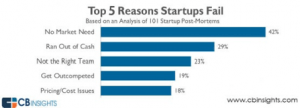
A no. of recent studies has shown that most the start-ups fail due to a LACK OF MARKET NEEDS. (Fig below). And that is where the relevance of DESIGN THINKING comes into effect.

user


user

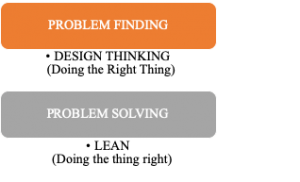
Design Thinking is a design methodology that provides a solution-based approach to solving problems.

It’s extremely useful in tackling complex problems that are ill-defined or unknown, by understanding the human needs involved, by re-framing the problem in human-centric ways, by creating many ideas in brainstorming sessions, and by adopting a hands-on approach in prototyping and testing. (www.interaction-design.org/)


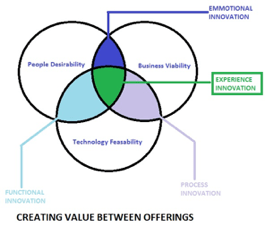
userWhile applying the concept of design thinking into any domain of business, say public service organizations, it is imperative that we keep people at the center and ensure that it creates delight by going above fulfilling their emotional needs.


Making it just convenient by introducing new processes and functionality is generally not enough to ensure your customer keep coming back to you,

EXPERIENCE INNOVATION IS THE KEY.

For any Public service organization, the key challenge is the diversity in its customer segment, which makes the utility of the concept even more desirable. Moreover, the vulnerability of its target audience and the pressure of ensuring the success of the concept make it prudent to apply design thinking.

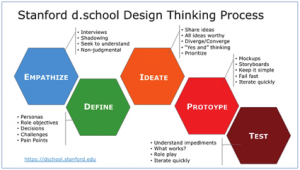
The easiest five-stage Design Thinking model proposed by the Hasso-Plattner Institute of Design at Stanford (d.school), helps reducing the risk of failure and ensures to give insights that make innovation more market-ready. (Fig below)

user

Successful innovations are defined by the intensity of collaborations with the market. It is inevitable to involve and take feedback from direct consumers while developing solutions.

7C’s of Innovation as beautifully devised by team IIT Bombay very well defines the process of Innovation using design thinking. The 7 concerns are- Cause, Context, Comprehension, Check, Conception, Crafting and Connection,

The first 3 steps- Cause, Context, and Comprehension revolve around understanding the Users. (Make efforts to study not only the primary users but Secondary and tertiary as well).

Check is about creating the checklist of the product brief to ensure that the solution promises the asks from the consumer.

Conception and Crafting are about working out on ideas and concepts and finally building prototypes and mock ups of the champion Idea.

And lastly, Connection is all about going back to the customer, taking feedback and continuing the efforts of innovating the Product/Service to ensure relevance in the changing competitive environment.

The methodology of Innovation is changing. The story of taking the product from the lab to the market has been changed to bringing the problems to the labs for successful innovations. The Sustainable Development Goals is an example of such an approach where researchers and innovators are encouraged to pick up a problem, stay close to the beneficiaries and devise solutions that are largely accepted, adopted, and are sure to create impact. For any public service organization where usually the market is big, the inclusion of and continuous intervention by all their possible categories of customer personas while innovating is crucial.

Design Thinking is iterative and the way towards successful innovation and should become a part of the culture of any organization to ensure its sustainability and growth.


IoT in Smart Manufacturing, Smart Clinic & Telemedicine

Introduction

How the Internet of Things (IoT) has become a sensational phenomenon?

It is the influence on the global network of data exchange and communication that has made it immensely popular in almost every industrial sector across the globe.

Furthermore, the rise of industrial IoT has led to the widespread utilization of automation in the industry. Moreover, it has also opened up new doors of opportunities ranging from embedding building blocks to devices using cloud services, and much more.

Such is its sway that every industry whether it is smart manufacturing, smart healthcare, and even telemedicine is incorporating IoT app development services. Besides, it will make sure that every prospect involved in the given sectors can avail benefits of the IoT to improve their fortune and make the life of people easy and safe.

The given blog will offer a glimpse of the power of IoT and how it has made a positive impact on three crucial sectors (smart manufacturing, smart clinic, and telemedicine). Further, it will also consolidate the dominant position of IoT in this digital world.

IoT & Smart Manufacturing: Driving Key towards Industry 4.0 Transformation
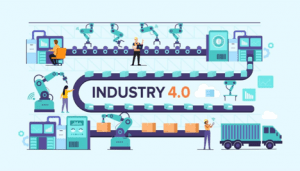
Before proceeding forwards, first of all, we must understand the concept of smart manufacturing. It is essential to answer the following question:

‘What is smart manufacturing. How is it related to IoT?’

Smart manufacturing (SM) is an approach that uses internet-based automation prospects and combines them with data analytics to enhance manufacturing performance.

Smart manufacturing solutions help factory managers to collect data automatically and analyze them to optimize production.

Now, how does IoT assist Smart Manufacturing in improvising their production?

The exciting part about the given technology is that it combines the best part of both wired and wireless connections and leverage it to monitor and manage the process in real-time. There’s more,

Taking the help of a reputed IoT application Development Company is good because you can:

  • Latest Technology Stack on IoT implementation
  • Forward-looking hardware and software
  • Improve manufacturing outcomes
  • Speed-up production
  • Waste reduction
  • Establish Overall Equipment Efficiency

There’s another secret that IoT comes up for Smart Manufacturing! It provides meaningful full insights on your production processes, resource utilization, the productivity of machine & workforce etc. It offers meaningful insights into the consumption of products by consumers. If you assess it, understanding features to provide real needs to the consumer at the marketplace are not a problem.

In the next step, we will evaluate current market statistics. Let’s move on.

A view of IoT in Industry 4.0

In the manufacturing sector, IoT Platform development is a hot topic of discussion, especially among people in management positions. According to the study from IDC, IoT-powered operations have seen a massive improvement of over $470 billion in value per year.

Modern smart factories have seen the biggest boost in their performance after implementing IoT and smart sensors. Now, IoT-enabled smart manufacturing (industry 4.0) shall see an annual growth rate of 12.4% by 2025.

Apart from them, another fact reveals the complete dominion of the IoT ecosystem in the SM. The projection of the global market for industry 4.0 will scale upwards from US$90.6 Billion in 2020 to US$219.8 Billion by 2026.

What do these facts signify?

It indicates optimization of IoT in smart factory 4.0 enhances business profitability. Moreover, implementing IoT helps smart manufacturing companies to offer automation solutions at reduced cost with no compromise on quality.

IoT Trends in Industrial Manufacturing

IoT is revolutionizing the world of industrial manufacturing manifold. It has made it possible in creating connected products and develops a service-based prototype to prepare the manufacturing sector with full digitalization.

Several trends will define the next path for industry 4.0:

1. Rise of M2M Automation

 Machine-to-Machine Automation will become part of every manufacturing product to communicate and automate decisions with no involvement of human interactions. To make it more feasible, integrating data with enterprise software is the most probable solution.

2. Secured Cloud Solutions

Contrary to others, cloud-based IoT networks are less likely to get attacked by data breaches. Similarly, the evolution of information assurance (IA) services will likely reduce more cyber- attack.

3. IoT Data will Gain Prominence in Future

In the future, security will be given paramount importance by manufacturing sectors. So, they will collect big data from IoT platforms for any predictive analysis and generate a lot of digital insights over a period of time.

4. IoT & ERP will Modernize Supply Chain

There will be unique visibility in the supply chain, all thanks to a combination of ERP into IoT. Sophisticated ERP software will combine IoT to share and analyze data to make smart decisions and make accurate predictions for a better future.

IoT in Smart Clinic: Exploring New way of Smart Healthcare with IoT

Before moving forward, first, we will get our readers to understand the concept of the ‘smart clinic.’

As per the medical experts, smart clinics are a group of private healthcare service providers who thrive on delivering the best healthcare services through home monitoring tools, skin sensors, and wearable. Likewise, it is the place where a network of hospitals with their people, infrastructure, clinical processes, etc., comes under a single system to offer effective healthcare.

There are several and varied benefits that come with IoT-based Smart Clinics. They are as follows:

  • IoT systems ensure safety for physicians and patients
  • IoT system permits physicians to monitor patients with a high level of precision
  • It allows easy integration for future-proofing

The next step will help the reader to analyze the market states about the smart clinic.

A view on IoT in Smart Clinic
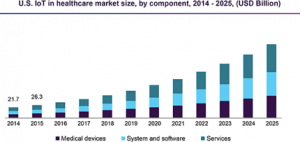
After the havoc played by COVID-19, the healthcare sector was smart enough to use IoT technology in the creation of a ‘smart clinic’. In addition, the emergence of technologies such as Artificial Intelligence (AI) and Machine Learning (ML) is driving the market demand for smart healthcare services.

Additionally, multiple facts showcase the importance of IoT in the smart clinic, such as:

As per the above facts there is a surge in the need for cost control measures. Moreover, a sudden increase in the demand for patient-centric care has compelled smart hospitals to opt for IoT connectivity.

Also, the arrival of Artificial Intelligence in healthcare has allowed healthcare providers to bank on real-time data for offering immediate healthcare services. This is where IoT technology help to develop connected devices to provide the data the healthcare provider seek for their information.

IoT Trends in Smart Clinic

With the dawn of 2022, several trends will define the essential role of IoT in the smart clinic. Some of them are:

a. Improvise Connectivity through 5G & Edge Computing

 IoT app development solutions have opened vast floodgates by improving connectivity in healthcare services. It has been made possible through two innovative solutions: edge computing and 5G networks.

  • 5G Networks: It offers greater security and high scalability. Besides, it also improves remote monitoring for patients and equipment.
  • Edge Computing: It works with 5G to create decentralized infrastructure to minimize bandwidth issues and latency.

b. Remote Monitoring will Expand Manifold

In the future, the recent trends point towards the use of IoT solutions to monitor and track the assets of the patients. To maximize proficiency, a real-time location system (RLTS) will find more usage in limiting theft and misplacement of assets.

IoT in Telemedicine: Feature of Success in the Medical Sector

Before moving forward, first, we will understand the concept of telemedicine. There will be a question in the mind of people:

‘What is telemedicine, and how does IoT improvise the whole healthcare sector?’

Basically, telemedicine is the utilization of electronic information to offer and support healthcare facilities to patients residing in remote or inaccessible areas. Here, video and phone appointments take place between doctors and patients with telemedicine software to make their health better.

IoT in Telemedicine is another area of the healthcare industry that is rapidly growing. It has simplified the lives of busy individuals by allowing them to obtain medical treatment remotely at a reasonable cost.

There is tremendous growth going on in IoT in the telehealth industry. Just like that, several healthcare treatment procedures, and even IT communication has seen quite an improvement due to telemedicine software.

What’s more, for people suffering from chronic diseases, old age-related symptoms, or lifestyle illnesses, remote care through telehealth services is the best way to avail of health benefits.

Now, there is a question: ‘How is IoT actually a boon for telemedicine companies?’

There are many ways where IoT is helping telemedicine organizations to reach every nook and corner so that people can access improvised healthcare facilities. Some of them are:

  • Doctors are the great beneficiary as they can retrieve essential data from medical devices via IoT wearable devices
  • Real-time monitoring offers each minute details about the patient’s health every second
  • Senior citizens can reward them with good healthcare without support through the use of speech-enabled devices like Alexa

Role IoT Plays in Telemedicine

If you are looking to integrate IoT in telehealth, then seek out some facts that demonstrate the supremacy of technology. Several aspects point towards it.

Let’s dig more into it:

The given fact reveals that people have become more aware of health. Even medical healthcare practitioners are vouching for IoT-based devices such as medical wearables. Due to them, almost 50% of people now are using wearable devices to monitor their health vitals like sugar levels, heart rate, and others easily. Further, doctors can collect info and offer medical aids based on it easily as per their convenience This has helped the healthcare providers to prescribe the best-in-class services and medications even remotely to the rural areas

IoT Trends in Telemedicine

 IoT is expanding its footstep in every corner of the healthcare sector. Are you still having some concerns? Then let’s check out some trends that emphasize new aspects that will define the role of IoT in telemedicine.

So, we go through them:

a.Telehealth Robots will become a Reality in Remote Monitoring

 IoT-run robots can replace doctors in remote patient monitoring. During COVID-19, many global hospitals utilized them to navigate patient checkups and permitted doctors to interact with them far away to avoid contact.

b. Personalized Healthcare will be Successful in Future

 The future of telemedicine belongs to personalized healthcare. They will become a crucial factor in decreasing the risk of human loss by predicting health info in real-time and permitting doctors to use them in an emergency.

c. Integration of MHealth in Telemedicine will Reap Surplus

Simply speaking, it is an innovative way to use mobile technology to enhance the health goals of people. MHealth apps will assist patients to get better management of their health status that will enhance satisfaction rate among them and their physicians in the future.

Conclusion

At last, IoT platforms are gaining significant prominence in the manufacturing and healthcare sectors. With IoT solutions at the helm, smart manufacturing is unraveling enormous opportunities to automate industrial operations to build new systems from scratch.

Also, the telemedicine or telehealth development requirements are being in line with personalized healthcare services and are asking IoT platforms developers to create remote healthcare facilities to provide medical aid to the needy.

Hence, the future of IoT in smart manufacturing, smart clinic, and telemedicine is bright. So, it is correct to say IoT will remain omnipresent and offer more comfort and convenient facilities to the customers.

Leveraging Backhaul in Transportation and its impact on cost

In fact, logistics system is very complex in nature. The importance of good logistic system is growing tremendously due to its practical importance and robustness. There are many challenges in logistic system like resiliency in logistic system i.e., how to reduce the severity and likelihood of disruptions in systems. An effective and efficient logistic system makes industry competitive and profitable.

In developing country, 90% of its industries are small and medium enterprises (SME). To achieve resiliency in logistics is considered the best way to reduce the severity and likelihood of logistic system disruption. In India, more than 60% cargo is being moved by road and half of its’ (32%) through rail. So, we need to be developed better systems to manage- to build resilience like visibility, control, flexibility and collaboration.

Visibility – Capable to track and monitor, even foresee the logistic events and patterns. This helps organization to address the issues in logistic system before becoming a problem Flexibility – Capability to respond quickly (Agile) to problems without much hike in operational cost. It optimizes the impact of a sudden shift or disruption.

Collaboration – Helps to build trust-based relationship with others

Control – Helps to ensure proper procedures and process which follows in the organisation by implementing robust policies, control mechanisms

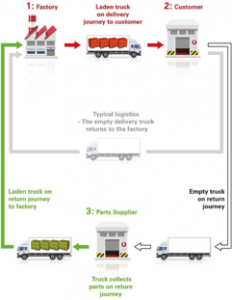
Presently, many organisations are leveraging backhaul mechanism in their products distribution. In backhauling the trucks after delivering goods, returning to original destination in empty condition are being hired by another company and they are loading the vehicle with their product and shipped to the destination which will be near or on the way to the starting point of vehicle. The backhaul challenge in transportation is characterized by an imbalance in transport flows between  two  locations.  A backhaul,  as  it  relates  to  trucking  capacity  and logistics, is the return trip of a commercial truck that is transporting freight back over all or part of the same route it took to get to its current location. Empty trucks are not ideal for anyone in the supply chain and empty miles are expensive. They aren’t as safe to drive, put drivers at increased risk and they aren’t filled with product, so it drives up the cost in the supply chain in labour, empty miles and fuel emissions.

The concept of backhaul, or utilizing freight asset outbound to delivery point and back, has always been applauded in theory and stymied in practice by the logistical challenges of:

  • Matching the supply with the demand in the specific lane;
  • Collaborating with outside of existing trading partner relationships;
  • Honouring the financial and contractual relationships established in the transportation market;
  • Combination of demand and available truck types in particular lane

With transportation capacity more limited now than ever (industry estimates between 25-50 percent of the trucks are empty), optimizing all assets in our logistics network is paramount.

Backhaul or reverse optimization has been one of the much touted and anticipated impacts of technology in this industry, though we think that these network effects will take time to manifest itself in a more meaningful way. The idea behind network

optimization is to use technology and the data available on an extensive scale to enhance the efficiency of load matching, planning and routing.

For example, after travelling from point A to B, a truck might not be able to get an immediate load from B to A. This leads to idle time and revenue loss due to lower asset utilization. But with visibility over the larger network, one might be able to identify loads from B to C & C to A leading to better utilization of the asset (truck).

In theory everything sounds right but reality is tricky. The market is not so homogenous. There is variability in several factors including the type of truck required (body type, tyre type etc.) Further, aspects like route preference, and non-uniform distribution of demand/supply canters in the country make the network optimization a much more challenging problem which is yet to be solved.

Building for scale is one of the ways to reach network effect. However, given the heterogeneous distribution of demand and supply, building micro networks backed by technology might be an approach worth exploring. Identifying micro-networks where the variables of the supply chain can be controlled and driver behaviour can be influenced can help unlock network effects at a much smaller scale. Such networks would allow for better visibility of the supply chain and higher asset utilization.

Just to highlight the magnitude of impact, let’s consider an example. Today a long-haul truck in India has 12-17 billable days and spends the remaining time in loading/ unloading, maintenance, waiting for loads or doing sub-optimal loads. In the process, an average truck driver takes home anywhere between Rs 20,000 -Rs 30,000 after working 16 hours a day in very unpredictable and harsh working conditions. An optimized network with 20 to 24 days of utilization can help push up the revenue of these vehicles by about 40% to 60% and will at least double the income of the driver cum owners.

(*This is because, once a truck has been purchased, bulk of the cost is fixed cost for the driver cum owners in the form of EMI, insurance etc.)

 I had an experience to explore optimized organisation’s freight cost by leveraging the backhaul. In the study, we had chosen two other organisations with us to make a cluster formation. Let say my organisations, manufacturing facilities had in south part of India, other two company’s either their manufacturing capacity or main hubs in West and North. For better understanding, denoting these 3 organisations – A, B and C. Let say, A had manufacturing facilities in South and distribute its’ products to West and North India, B had one production facility and Hub in Bhiwandi, West and similarly, C had Hub and manufacturing capacity in Western UP in North India. Before reverse auction of each lane, we took consideration of 3 organisations to and back monthly volumes and estimated future demand truck types. Based on these exhaustive working, we finalised transporters for each lane and did reverse auction. End of it, we procured 6% lower cost. Awarded freight agreement to business partners based on auction and intend to start business. But roughly a week later, we faced havoc service issues and ultimately, we had to force to withdraw the freight agreement and implement pre-auction freight and vendors to resume the business.

Although the concept is sacrosanct but when it back-fired we did self-introspection and certain points surfaced:

  1. The data shared by individual organisation like lane wise volume, truck types, freight cost, etc was not correct
  2. The wrong information shared by individual organisation in anticipation not to disclose market shares
  3. Post reverse auction, organisations had not made agreement with lowest quote transporters due to lack of confidence and less known each

So, as per my suggestion to make it more robust and feasible:

  1. Make clusters with organisations who are predominantly in different business segments
  2. Before start process, all parties should sign NDA (Non-Disclosure Agreement), hence no-body will be hesitant to share correct information
  3. Pick the right industries so that mis match of truck types avoided; e.g. clusters should be avoided between Cement manufacturing company and Medium sizes FMCG company rather Paper and Cement manufacturing organisation would be ideal
  4. Process of reverse auction should be arranged in this manner so that at least one existing vendor should present in each lane, so organisations along with new get confidence to run business.
  5. Low volume lanes should be avoided to do reverse auction because my own experience sharing of business within 2-3 vendors, no-body will be

The level of backhaul discounting is obviously market-driven for the most part. In cases where fronthaul trips are destined to weak outbound markets, fleets must make the money on the outbound trip to compensate for the weaker return market.

Problem arises when this becomes entrenched in the psyche of a company’s operations personnel. Not all markets exhibit excess capacity, but somehow all backhauls become eligible for steep discounts. In many cases, companies discount backhauls rates by 40% or more. This discounting presents the shipping public with an unconscious and unrealistic view of the company’s overall service value.

It is a sobering fact that, even with driver shortages and capacity constraints, more than 20% of truck miles are driven empty. It may be more sobering to contemplate that the empty percentage number should possibly be higher.

One key performance indicator (KPI) that determines good trips from bad for most companies is the percent of empty miles to total distance travelled.

A good counter to the percent of empty miles is total revenue per day per truck. This KPI introduces time into the equation. It makes no sense for a company to accept a load that parks a truck for too long. Companies need to achieve a balance between these two metrics to increase profitability. This is all basic business. But companies should take a fresh look into how this plays out as it relates to getting drivers’ home.

One of the best way companies can minimize the effects of hauling out of a weak market is to utilize the closest stronger market as a springboard. For example, they may have to take less per mile to get out of small town, but the rates out of Metro or Industrial Town are much better. Ideally, they would take a shorter trip to Metro City at depressed market rates to minimize the impact of the low rate. Once in the better market, companies can take advantage of higher rates for a greater percentage of the haul.

It often works out that a deadhead into the better market is the best option for the company’s business. This may seem onerous since operations has to deal with at least two transactions instead of one, but technology exists to automate this decision process for the team and even optimize to preferred KPI. There is potential to sharply increase profitability. The cost of that increase is the backhaul mindset.

Yes, drivers need to get home on a predictable schedule and this sometimes requires fleets to make tough decisions to maintain a dependable workforce. Carrier companies can stop depressing the overall market (and therefore driver’s wages) by negotiating against themselves from the outset. The concept of backhauls taints how the value of capacity is calculated and has made some fleets lazy in their operations. Stop calling it a backhaul and get the fleets on board.

Sound of Silent Talks

It’s never too late to start again

Humbled request to all the readers to immerse themselves to experience my Zero fiction narrative, as a short & real-life serial wherein, the “Sound of Silence, of life 2.0, Innovated in Eureka Moments as a One-Man Army & Captivating Global Influencer after Forever loss of my Natural Speaking ability into Exceptional Opportunities for the quarter of the century in a row”.  

In this blog, you will have an immersive experience of reading zero fiction following narratives, resiliently demonstrating life 2.0 as a common man: 

# from Disabled to Enabled with Distinctly Audible UniqueVoice as a Captivating global Influencer

# from Ashes of Stage IV vocal cord cancer victim to Patient Leader Hero Awardee in the USA out of 21000 nominations. 

# from International Marketeer to Counselor, Advocate, Inspirational Speaker, Mentor, Anchor, Interviewee, honorary member of Della Leaders Club, a global platform. 

“The words, “Silence Zone” we read in the hospital, courtroom, classroom, library, Tedex talk, etc.

You can see dreams you have worked hard for the years getting crashed like a quake in front of you especially, being the only wage earner of the family at the age of 44!  

A vivid industrialist, a trendsetter international businessman, and entrepreneur got diagnosed with stage T4aNOMO, IV. A vocal cords cancer in September 1997 & lost my natural speaking ability for a lifetime. Underwent nearly 9 hours long wide-field massive surgery followed by 30 rounds of radiotherapy.

As the first step, I bravely accepted the diagnosis and the result – a resounding victory over advanced-stage cancer. 

I began trying to return Life 2.0 to normalcy by using pen and paper in place of my natural voice to communicate as a dependent vocal cord cancer survivor which was totally against my WILL.

In December 1997, I started practicing speaking with a handheld electro-larynx as the services of a speech and language therapist were not available, and I had to learn on my own to locate a sweet spot under my chin from where audible sound could be generated.  

While speaking in public with my differently enabled voice, I encountered total rejection in the first place, people were running away from me because they feared the weird sound.

It was a completely catastrophic condition, yes, you are reading Right!  

It was a thought-provoking and challenging time for me, individually, socially, financially, for my family too.

Moreover, I decided NOT TO QUIT under any circumstances, especially the challenge of rejection of my new voice.

As export marketing was my key job function, I continued speaking with my newly developed voice with full courage and confidence and without any fear, continued my international business same as before traveling alone, meeting customers, and speaking with them over the phone.

The best advantage of my differently enabled voice is that the moment I start speaking over the phone, I am not required to announce my name – people recognize my voice immediately & another 10 years passed.                                                                                                                          

Needless to say, there was full-time, unparalleled support from my wife, Nilam, sons, Maulik, and Ankit.

Caregivers are the backbone, and without them, the journey is incomplete.

Being a die-hard marketeer & with a troubleshooter mindset, in 2011, indulged in Innovating my Life into “Eureka moments by creating Exceptional opportunities & first step was to demonstrate my weakness, the loss of natural speaking disability because of advanced-stage cancer & the daily paranoid difficulties, I experienced, as the first dependable tool for the public.

“Seeing me speaking with my distinct voice”, gave the most needed, “HOPE” to 40000+ patients, caregivers, students, working professionals & super specialists doctors by emphasizing quality of life after cancer, demonstrated Courage & Freedom From FEAR through numerous & extensive professional live presentations, interviews with slides worldwide.  

Invited to address a huge audience in an auditorium, medical professionals, super specialists, change-makers & received a prestigious award at the hands of the Chief Minister of Gujarat.

Published my biography, “SHAHENSHAH”in June 2020 which was the first as a vocal cords cancer survivor. 

My journey was featured as chapter 1 of the coffee table book 10/10, with the chapter title ‘I Am Here to Stay” also in the book, “Tame Ekla Nathi”(You are not alone), in numerous newspapers, newsletters, books globally & 3 books are under publishing as a co-author including one in the UK.

It’s my relentless surge to touch the lives and hearts of millions through my speaking events at:  

# My contributions are appreciated by UICC, Geneva having a presence in 170 countries for cancer control & many other awards, accolades, recognitions such as Victor & TIMA, etc. & accolades to date.                

# Invited to give kick start presentation during the annual conference in the USA for 2500 global attendees. 

# Consecutively sponsored twice to the UK to address annual conferences. Delivered talk at London Cancer Care, Guys Thomas Cancer Care, Mount Vernon, UCL, Olympic village.

# First time in the world, as a vocal cords cancer survivor, conceptualized, anchored, streamed 20 episodes of e-health series with 35000+ views & more are being scheduled.

#Prof., Dr. Martin Birchall, Briton of the year 2008 from UCL, recommended my name for the Stovall Award in the USA & Atos Medical, Sweden having a presence in 70 countries, featured my journey.

  I survived my last staged cancer diagnosis. Thanks to my ‘will to win’ approach coupled with what I have learned so much for 25 years from the university of experience and living with, especially acceptance, courage, confidence, and troubleshooting & to live in the moment

I am grateful to God for giving me a bonus Life 2.0. I spend every moment of life without any regret and without seeking sympathy. I express deep gratitude to one and all who were, are and will be part of my cancer-winning journey.