


I AM TAXONOMY PAGE
Chapter: Ahmedabad
Sound of Silent Talks
It’s never too late to start again
Humbled request to all the readers to immerse themselves to experience my Zero fiction narrative, as a short & real-life serial wherein, the “Sound of Silence, of life 2.0, Innovated in Eureka Moments as a One-Man Army & Captivating Global Influencer after Forever loss of my Natural Speaking ability into Exceptional Opportunities for the quarter of the century in a row”.
In this blog, you will have an immersive experience of reading zero fiction following narratives, resiliently demonstrating life 2.0 as a common man:
# from Disabled to Enabled with Distinctly Audible UniqueVoice as a Captivating global Influencer
# from Ashes of Stage IV vocal cord cancer victim to Patient Leader Hero Awardee in the USA out of 21000 nominations.
# from International Marketeer to Counselor, Advocate, Inspirational Speaker, Mentor, Anchor, Interviewee, honorary member of Della Leaders Club, a global platform.
“The words, “Silence Zone” we read in the hospital, courtroom, classroom, library, Tedex talk, etc.
You can see dreams you have worked hard for the years getting crashed like a quake in front of you especially, being the only wage earner of the family at the age of 44!
A vivid industrialist, a trendsetter international businessman, and entrepreneur got diagnosed with stage T4aNOMO, IV. A vocal cords cancer in September 1997 & lost my natural speaking ability for a lifetime. Underwent nearly 9 hours long wide-field massive surgery followed by 30 rounds of radiotherapy.
As the first step, I bravely accepted the diagnosis and the result – a resounding victory over advanced-stage cancer.
I began trying to return Life 2.0 to normalcy by using pen and paper in place of my natural voice to communicate as a dependent vocal cord cancer survivor which was totally against my WILL.
In December 1997, I started practicing speaking with a handheld electro-larynx as the services of a speech and language therapist were not available, and I had to learn on my own to locate a sweet spot under my chin from where audible sound could be generated.
While speaking in public with my differently enabled voice, I encountered total rejection in the first place, people were running away from me because they feared the weird sound.
It was a completely catastrophic condition, yes, you are reading Right!
It was a thought-provoking and challenging time for me, individually, socially, financially, for my family too.
Moreover, I decided NOT TO QUIT under any circumstances, especially the challenge of rejection of my new voice.
As export marketing was my key job function, I continued speaking with my newly developed voice with full courage and confidence and without any fear, continued my international business same as before traveling alone, meeting customers, and speaking with them over the phone.
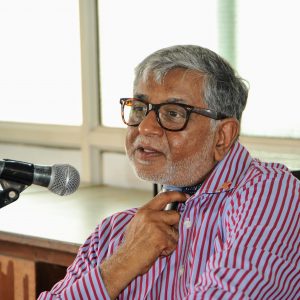
The best advantage of my differently enabled voice is that the moment I start speaking over the phone, I am not required to announce my name – people recognize my voice immediately & another 10 years passed.
Needless to say, there was full-time, unparalleled support from my wife, Nilam, sons, Maulik, and Ankit.
Caregivers are the backbone, and without them, the journey is incomplete.
Being a die-hard marketeer & with a troubleshooter mindset, in 2011, indulged in Innovating my Life into “Eureka moments by creating Exceptional opportunities & first step was to demonstrate my weakness, the loss of natural speaking disability because of advanced-stage cancer & the daily paranoid difficulties, I experienced, as the first dependable tool for the public.
“Seeing me speaking with my distinct voice”, gave the most needed, “HOPE” to 40000+ patients, caregivers, students, working professionals & super specialists doctors by emphasizing quality of life after cancer, demonstrated Courage & Freedom From FEAR through numerous & extensive professional live presentations, interviews with slides worldwide.
Invited to address a huge audience in an auditorium, medical professionals, super specialists, change-makers & received a prestigious award at the hands of the Chief Minister of Gujarat.
Published my biography, “SHAHENSHAH”, in June 2020 which was the first as a vocal cords cancer survivor.
My journey was featured as chapter 1 of the coffee table book 10/10, with the chapter title ‘I Am Here to Stay” also in the book, “Tame Ekla Nathi”(You are not alone), in numerous newspapers, newsletters, books globally & 3 books are under publishing as a co-author including one in the UK.
It’s my relentless surge to touch the lives and hearts of millions through my speaking events at:
# My contributions are appreciated by UICC, Geneva having a presence in 170 countries for cancer control & many other awards, accolades, recognitions such as Victor & TIMA, etc. & accolades to date.
# Invited to give kick start presentation during the annual conference in the USA for 2500 global attendees.
# Consecutively sponsored twice to the UK to address annual conferences. Delivered talk at London Cancer Care, Guys Thomas Cancer Care, Mount Vernon, UCL, Olympic village.
# First time in the world, as a vocal cords cancer survivor, conceptualized, anchored, streamed 20 episodes of e-health series with 35000+ views & more are being scheduled.
#Prof., Dr. Martin Birchall, Briton of the year 2008 from UCL, recommended my name for the Stovall Award in the USA & Atos Medical, Sweden having a presence in 70 countries, featured my journey.
I survived my last staged cancer diagnosis. Thanks to my ‘will to win’ approach coupled with what I have learned so much for 25 years from the university of experience and living with, especially acceptance, courage, confidence, and troubleshooting & to live in the moment
I am grateful to God for giving me a bonus Life 2.0. I spend every moment of life without any regret and without seeking sympathy. I express deep gratitude to one and all who were, are and will be part of my cancer-winning journey.
Reducing the risk of frauds on Debit/Credit cards while online banking
How a big security breach managed to disrupt Twitter
How ESG affects Corporate Credit Risk and Performance?
73 Questions with Dr. Gaurav Buch
Welcoming our New Member, Utpal Vaishnav | CEO | Upsquare Technologies to World’s First Business Platform
Enabling circular economy through waste management
Waste collection and management are among fundamental services which ensure the healthy well-being of society. Today, the rate of waste generation exceeds the nation’s growth in waste management services, posing a threat to people and the environment. One can easily notice dumping of waste being practiced in any city’s outskirts or burning of the same on roadsides, indicating lack of awareness and sensitivity towards right waste practices, posing several challenges. Waste has the potential to become a resource. When not segregated and processed right, it can lose its value. This is the gap that NEPRA has identified and has decided to eliminate through innovative models enabling a circular economy.
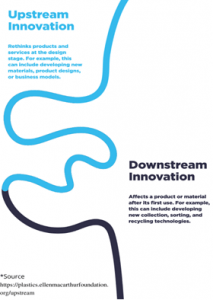
To achieve a circular economy, two types of innovations are crucial.
First, Upstream Innovation, rethinks the problem at its source stage thus, designing models, services, and products at the initial stage.
Second, Downstream Innovation addresses the problem that affects the product or material after its first use.
Waste management in India is largely moved by the informal sector, i.e. people belonging to the Bottom of the Economic Pyramid (BoEP) communities. Waste in the country is majorly hand-sorted, which is not only time-consuming and labor-intensive but also is hazardous to health. With the rising quantum of waste, only relying on this method is proving to be inefficient. NEPRA’s model helps solve these challenges. An inclusive model in its true sense, it caters to the needs of all formal and informal stakeholders of the waste management sector, making it efficient. The cities in which NEPRA works are an example of the impact it makes by bringing government, waste pickers, commercial establishments, industries, and citizens on one platform. Taking the upstream innovation approach, NEPRA has rethought its model and has inculcated an inclusive stakeholder approach benefiting all, and monitoring the system through an Enterprise Resource Platform (ERP). This has enabled the system to become more transparent and accommodate fair transactions. Addressing another source of the problem, NEPRA conducts awareness activities in which people are sensitized about the benefits of proper waste management on society, the environment, and the economy.
Downstream innovation as defined by the Ellen McArthur Foundation, “affects a product or material after its first use. For e.g., this can include developing the new collection, sorting and recycling technologies”. NEPRA’s Material Recovery Facility (MRF) is a vital infrastructural development that promotes sustainable practices and a circular economy. MRFs are the centers where collected waste material is sorted into different types (e.g. plastics, paper, metals, glass, etc.) and is processed in such a way that it maximizes waste recovery and eliminates the scope of dumping of waste. NEPRA’s automated MRFs have been innovatively designed having home-developed and imported machinery. Waste at the MRF is sorted using magnetic belts, conveyors, ballistic separators, air classifiers, and AI-powered pneumatic sorters among many others with manual interventions for quality check. The introduction of robotics at the MRFs has increased its efficiency. Automatic sorting using machine vision systems based on machine learning and artificial intelligence has enabled sorting designated material from the belt of mixed dry waste and guiding it into their respective silos. Sorted waste is then generated into two streams- recyclables and non-recyclables. The waste is auto baled/ shredded/ grinded depending on its nature. The recyclable final product is sent to respective authorized recyclers and the non-recyclables are sent as Refuse Derived Fuel (RDF) to cement plants or waste to energy plants for energy recovery. Thus, having created a value chain for different waste streams, closing the loop to ensure circularity.
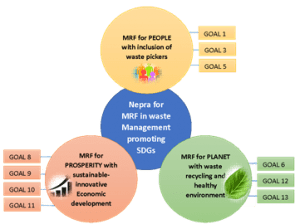
The impact of NEPRA’s model is 3-way, socio-economic, and environmental in nature. To mention a few, socially, NEPRA has helped uplift the BoEP community through collecting waste directly from them and engaging them at the MRF as formal employment. Environmentally, NEPRA has helped mitigate tons of GHG emissions through the right waste processing and curbing, dumping, and burning of waste. Lastly, economically, it has promoted circularity, reducing the burden on raw material, making the sector more efficient, and has also helped to generate green jobs. For brief understanding, one can align NEPRA’s impact to the United Nations Sustainable Development Goals (SDGs).
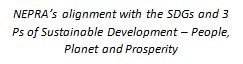
The diagram below lists the goals NEPRA meets, aligned with the 3Ps of People, Planet, and Prosperity.
At present NEPRA has its MRFs in 4 cities- Ahmedabad, Pune, Jamnagar, and Indore with a capacity of processing 560 Metric Tons of Dry Waste per day. By 2025, NEPRA’s goal is to have 25 MRFs in 25 major cities of the country.
To know more about NEPRA, visit: www.letsrecycle.in.
Tips to how HR can Motivate and Engage New Hybrid Workforces post Covid.
The pandemic has made the professional world more challenging than ever. With the backdrop of a more unstable workforce, organizations are realizing the value of efficient employees more than ever. With all the uncertainty and dynamism in the air, HR professionals are indispensable now.
Companies have had to tirelessly innovate the organization structures to accommodate changes. Due to frequent separation of employees, workflows have had to be redefined and manpower planning has become more complicated. Job descriptions have evolved and become more fluid, making recruitment more challenging amidst a shrinking budget. Given the current state of things, it is imperative for companies, both large and small, to focus on employee retention. Onboarding and building a sense of belonging in any new hire’s mind cannot be done through conventional means anymore. Earlier, the infrastructure of offices in itself played a role in engaging new employees. But now, HR is forced to think outside the box.
One of the contemporary innovations is the hybrid working model, which combines both working from home and working from office. This has the potential of being both a boon or a bane, depending on the implementation. HR professionals have been brainstorming, ideating and endlessly improvising to ensure a committed and uninterrupted workforce. The crucial thing here is striking the right balance and enabling the transformation, both physically and psychologically. If and when employees are coming to offices, HR needs to plan what number of employees need to be available at the same time and at what intervals. Policies for this would range from planning the transport to understanding which employees are interdependent on each other. One common model evolving is where localites are being called to work first and people from out of station are being given the option to report to their nearest branch instead of one fixed branch. Even attendance policies have had to be reframed to define how many hours an employee has to spend at work. Productivity patterns have reformed a lot. After employees have worked from home for all these months, it will be difficult for them to sit at their desks and be continuously productive for hours at a stretch in office, especially in a hybrid model where working from home will still be in the picture. Policies to accommodate small regular breaks while working would need to be put in place. Plus, more attention needs to be paid to employees’ families, since schools are not operating like they used to.
One of the greatest weapons in an HR’s arsenal used to be recognition. However, not only is it more difficult to measure performance now, it is also more difficult for keep everyone updated with their peers’ accomplishments. Performance review policies need to be restructured to identify key performers. KRAs and KPIs must now be aligned with the new working model. With roles becoming more fluid and open ended, career objectives are also becoming multi-dimensional. A simple “Employee of the Month” is no more sufficient. Matrices to measure intangible contributions such as leadership skills need to be developed. This can be done by asking leading questions, communicating more often, and structuring rewards accordingly.
Communication policies too need to be redefined to make sure loyalty is built amongst the employees. Certain organizations have come up with virtual “water cooler” channels wherein employees can have informal communication in office hours. These channels are crucial for maintaining the balance. Periodic automated feedback, HR Skip meetings, monthly self-appraisal, are all some simple ways of implementing formal communication channels.
The most basic requirement of a hybrid model would be to blur the boundary between office and home. The comfort level at offices will have to be increased to make the frequent switches in work environment friction free. Actions for this could range from something as simple as putting more comfortable chairs in offices, to something as complicated as being focused on the output rather than work hours. However, that said, it is also essential to value work-life balance. Employers must realize that covid-anxiety is real and going forward, mental health needs to be factored into decision making.
The beginning of the pandemic witnessed a global recession with millions losing their jobs. But now that the world is slowly accepting the new normal, we are seeing what is being called “The Great Resignation” or “The Big Quit”. America saw as high as 4 million resignations in a single month (April 2021). Europe too has faced resignations from over 6% of its overall working population in some major economies like France, Germany, UK, Belgium, etc. China is facing a similar phenomenon. It is all due to a dissatisfied and displeased workforce. Employees are wary of joining an organization which may resort to lay-offs when crisis hits. Even MNCs like Microsoft and Apple are spending millions to retain talent. The only way to manage all this change is to give credit where credit is due. Value the invaluable role that HR plays in any organization and start acknowledging that human capital is the most expensive and potent one there is.